Shepherd’s huts
Discover the Charm of Shepherds Huts in the Lake District
Ten square metres, a log burner, and a window at the end of the bed. The most romantic and least practical thing you can book in Cumbria, and we mean that as a compliment.
TL;DR
- A shepherd's hut sleeps two, has a log burner, and occupies about 10–14 square metres. That is the whole proposition.
- Rates run £140–£230 a night, or £175–£290 with a private hot tub.
- Stargazing roof lights and lake views are the two features that command a premium. Both are worth it.
- Huts cluster in the Eden, Lyth and Winster valleys and around Ullswater. Very few sit near Windermere.
- Dog friendly is common. Do not expect space for a large dog and two people to move at once.
Finding Your Perfect Shepherd's Hut
Locations of Shepherds Huts in the Lake District
The Lake District suits shepherd's huts for a reason that has nothing to do with nostalgia: the hut form was invented for exactly this landscape. Cumbria's fell farms have been lambing Herdwicks in exposed fields for centuries, and mobile shelters on wheels were the practical answer. Modern glamping huts are a direct descendant of working equipment, which is why they look right in a Lakeland field and slightly odd anywhere else.
England's largest national park covers 2,362 square kilometres, and hut supply within it is uneven. Huts need a private spot with a view and a track for delivery, so they concentrate on farmland rather than in campsite fields.
| Area | Supply | Typical rate | Character |
|---|---|---|---|
| Eden Valley & Penrith fringe | High | £160–£250 | Drier, open farmland, hot tubs common |
| Lyth & Winster valleys | High | £150–£240 | Damson orchards, deep quiet, close to Kendal |
| Ullswater & Pooley Bridge | Moderate | £170–£260 | Lake views, steamer, Helvellyn access |
| Cartmel & the south | Moderate | £170–£280 | Good food, mild weather, Morecambe Bay light |
| Western fells, Wasdale, Ennerdale | Low | £140–£200 | Remote, dramatic, nothing nearby |
| Windermere & central valleys | Low | £190–£290 | Land is too valuable for one hut |
Availability and booking through peak season: huts are usually single units, so one booking sells the whole property. That means they behave like cottages rather than campsites. For July and August, book four to six months out. For May, June and September, six to eight weeks. Out of season you can often book a fortnight ahead and get a single night, which is nearly impossible in summer.
Booking a Shepherd's Hut
Harebeck Holidays at Thornbank Farm is a representative example of how Cumbrian hut bookings work. Small farm-based operations like it typically run one to three units and handle bookings themselves, which changes the process in ways worth knowing.
What booking direct with a small hut operator looks like:
- Check the calendar on the site's own website, which is more accurate than any platform.
- Email or ring with your dates and a specific question. Reply speed tells you a great deal.
- Expect a deposit of 25–30%, with the balance due two to four weeks out.
- Ask about firewood: included, for sale on site, or bring your own.
- Ask about arrival window, since a farm has other work and check-in is often 4pm.
- Save the directions offline. Farm addresses defeat satnavs regularly and signal is poor.
Where else to look. Glamping marketplaces carry the design-led end of the hut market with better photography and a commission baked into the rate. Regional Cumbrian letting agencies handle huts alongside cottages and are often overlooked. Large booking platforms carry fewer huts than you would expect, because a single-unit property rarely justifies the commission.
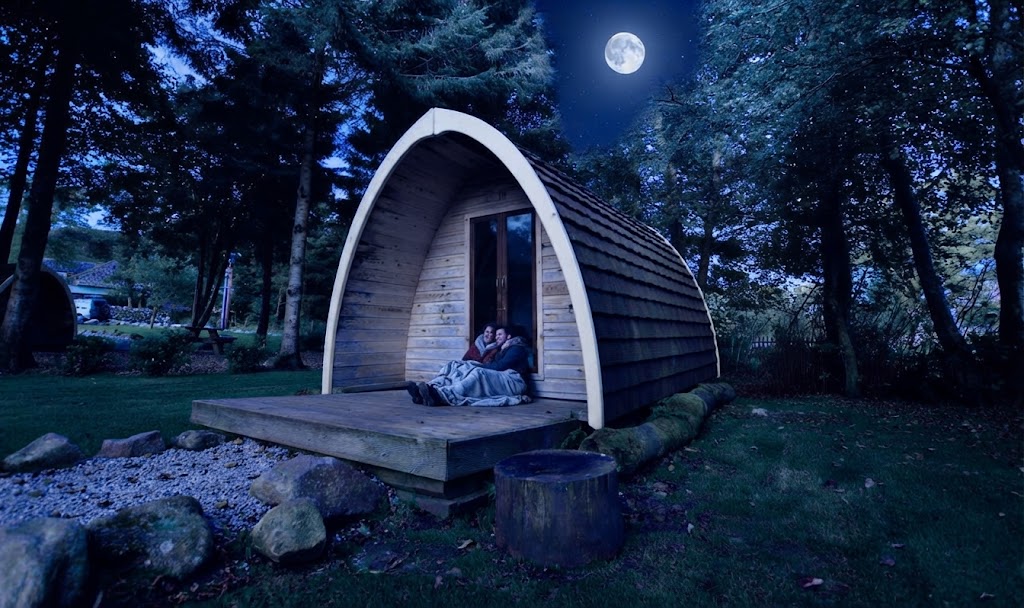
Glamping options beyond huts, if the size puts you off: a pod gives you similar footprint with year-round electric heat, a yurt gives you three times the floor space from April to October, and a safari tent gives you a kitchen and separate bedrooms.
Features and Amenities of Shepherds Huts
Unique Features of Shepherds Huts
Typical specification for a Lake District shepherd's hut:
- Footprint of roughly 3.6m by 2.4m, so 8 to 14 square metres internally
- Curved corrugated roof, timber-lined inside, insulated between
- Cast iron wheels, usually decorative on modern builds
- Double bed across the far end, often under a window
- Log burner, the defining feature, with a stovepipe through the roof
- Small table and two chairs, or a bench seat that converts
- Sometimes a compact shower room, taking a third of the length
- Sometimes a kitchenette — two-ring hob, small fridge, sink
- Decking or a step, often with a fire pit and two chairs outside
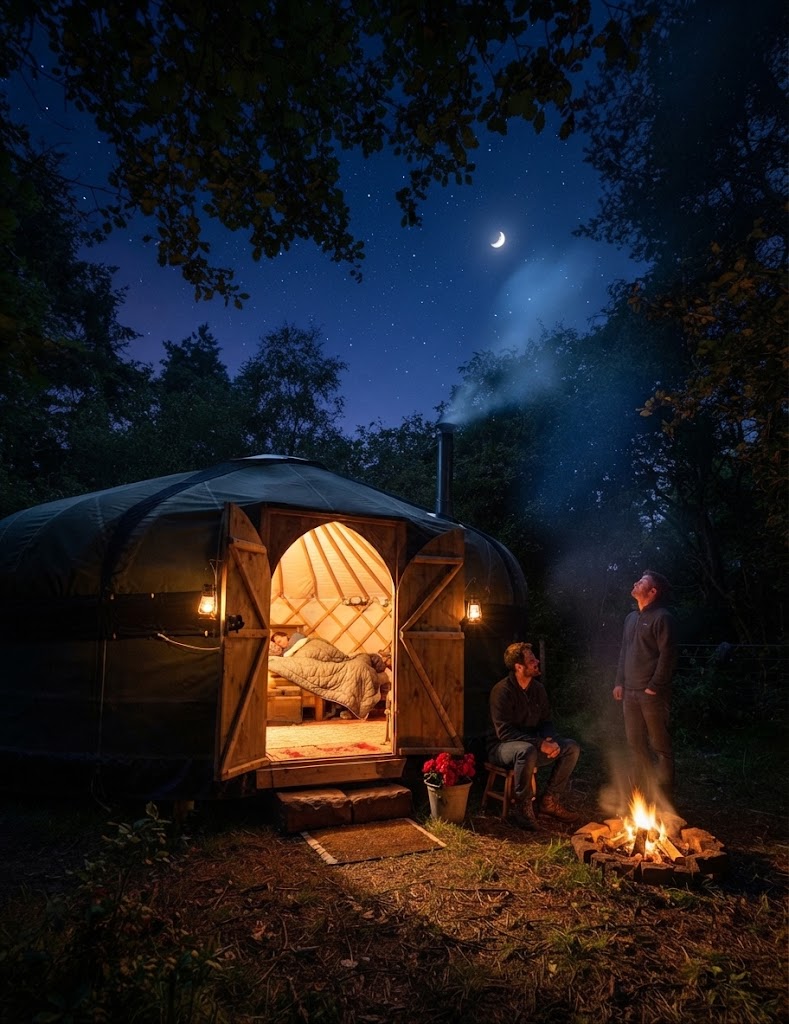
Stargazing roofs are the feature people remember. A roof light or glazed panel positioned above the bed turns the last twenty minutes of the day into something else entirely. This works in Cumbria specifically because the northern and western valleys have genuinely dark skies — low population, no motorway glow, and the fells blocking what light there is. On a clear night in the back o' Skiddaw you can see the Milky Way from a pillow.
Two caveats. Roof lights leak heat, so a hut with one needs the burner going. And a stargazing roof is useless if there is a security light on the barn thirty metres away, so ask.
Log burners do more than heat the hut. In a space this size the stove becomes the focus of the evening: you feed it, you dry socks in front of it, you sit closer to it than you would to a radiator. The practical notes: a small hut stove burns through logs faster than you expect, so establish whether wood is included or £8 a net. Kindling and firelighters are worth bringing. And open the vent properly before you close the door, or you will spend twenty minutes in smoke.
Lake views command a real premium and are scarcer than listings suggest. Genuine water views from a hut exist above Ullswater, on the eastern slopes above Windermere, and around the smaller southern waters. Everything else is a fell view, which is often better anyway. If the listing says "views towards the lake", assume you can see a strip of it through trees.
Dog-Friendly Shepherds Huts
Dog policies at Cumbrian huts are generally welcoming, with the obvious constraint that a hut is small.
| Item | Usual position |
|---|---|
| Fee | £8–£15 per dog per night |
| Number | One, sometimes two. Rarely more |
| Size | No formal limit, but the space imposes one |
| Left alone in the hut | Almost never permitted |
| On the bed | Site-dependent; many supply a throw |
| Enclosed area | Occasionally. Worth asking |
| Provided | Towel, bowl, sometimes a bed |
Benefits of a dog-friendly hut are practical rather than sentimental. There is no kennel cost, the dog is warm by the stove, and the whole of the Lake District's path network is open to you. Fell walking with a dog is one of the region's great pleasures and it is entirely compatible with a hut stay.
Travelling with a dog in Cumbria — the things that genuinely matter:
- Sheep are on the open fell, not just in fields. Lead on, especially March to May during lambing.
- Cattle with calves are the real risk on Lakeland paths. If cattle approach, let the dog off the lead and walk away separately.
- Bring two towels and a mat. A hut has no drying space at all.
- Blue-green algae blooms on still water in late summer and is fatal to dogs. Do not let them drink from scummy edges.
- Ticks are abundant in bracken. Check nightly, especially ears and armpits.
- Most Lakeland pubs take dogs. Not all. Check before you walk four miles to one.
More on this in dog friendly glamping in the Lake District.
Cost and Value of Staying in a Shepherd's Hut
Understanding the Costs
Average cost for two adults, one night:
| Specification | Low season | Shoulder | Peak |
|---|---|---|---|
| Hut, shared facilities | £95–£130 | £130–£170 | £165–£210 |
| Hut with private shower room | £130–£170 | £170–£215 | £210–£260 |
| Hut with private hot tub | £175–£225 | £225–£270 | £270–£340 |
| Design-led hut, lake view | £190–£250 | £250–£310 | £300–£390 |
Factors that move the price: season above everything, then private hot tub, then whether there is a bathroom inside, then view, then how many other units share the field. A single hut alone on a farm commands a premium over one of four in a row, and rightly.
Against other accommodation, for two people, one night, in season:
- Shepherd's hut: £165–£260. Two people, log burner, tiny, atmospheric.
- Glamping pod: £125–£240. Similar size, electric heat, open all year, less charm.
- B&B room: £110–£180. Bigger, breakfast included, indoors, no fire.
- Lakeland cottage: £160–£300 but usually three nights minimum. Far more space.
- Country hotel: £180–£350. Comfort, service, and you are inside a building.
Our honest read: a hut is poor value on square metres and excellent value on experience. For two nights it is close to perfect. For a week, two adults in ten square metres with Cumbrian rain outside will test any relationship. Book a pod or a safari tent for longer stays.
Experiencing the Lake District
Local Attractions and Activities
Activities near hut clusters, since huts sit on farmland rather than in towns:
- Walking. Hallin Fell above Ullswater, forty minutes for the best view in the park. Scout Scar above Kendal for the southern panorama. Helvellyn from Glenridding if you want a full day.
- Boating. Ullswater Steamers run between Glenridding, Howtown and Pooley Bridge, and work well as one-way transport for a linear walk.
- Swimming. Ullswater's eastern shore, the smaller southern waters, and the tarns if you like cold.
- Cycling. Lyth and Winster valley lanes for quiet road riding. Grizedale for waymarked trails.
- Eating. Cartmel is disproportionately good. Penrith's market on Tuesdays and Saturdays. Village pubs everywhere, with variable kitchens.
Stargazing and lake views are worth planning for rather than hoping for. Dark-sky quality in Cumbria is best in the northern fells, the western valleys and the eastern edge towards the Pennines. Take a red-filtered torch, give your eyes twenty minutes to adapt, and check the moon phase before you book if this matters to you. A full moon is beautiful and ruins astronomy.
Cultural and historical sites, for the wet afternoon that will come:
- Dove Cottage and the Wordsworth Museum, Grasmere
- Hill Top, Beatrix Potter's farm at Near Sawrey, run by the National Trust
- Brantwood, John Ruskin's house above Coniston Water
- Castlerigg stone circle near Keswick, free and best at dawn
- Lowther Castle and Gardens near Penrith
- Cartmel Priory, twelfth century and still in use
Visitor Reviews and Experiences
Reviews of Cumbrian shepherd's huts, including operations like Harebeck Holidays at Thornbank Farm, converge on a consistent set of themes.
What guests praise:
- The log burner, almost universally, and how quickly the hut warms up
- Privacy — single-unit sites deliver something hotels cannot
- Owners who left kindling, a bottle of milk and clear instructions
- Waking up with the window at the end of the bed showing a field of sheep
- The stargazing roof, where there is one
What guests criticise:
- Space. Two adults and luggage in ten square metres is genuinely tight
- Nowhere to dry wet walking gear
- Firewood running out, or costing more than expected
- Compact shower rooms where you cannot turn round
- Mobile signal, which on Cumbrian farmland is often absent
- Access tracks in poor weather
The broader insight from hut reviews: nobody regrets the hut, and plenty of people wish they had booked two nights rather than four. It is a format that is close to perfect for a short stay and gradually less charming as the week goes on.
Traveling to Your Shepherd's Hut
Travel Logistics and Tips
Getting to the Lake District:
- By road. M6 junctions 36 (Kendal and the south), 40 (Penrith, Ullswater and the Eden Valley) and 44 (the north). Inside the park, average speeds fall to about 30km/h.
- By rail. Oxenholme and Penrith on the West Coast Main Line. A branch runs Oxenholme to Windermere. Roughly 2h40 to 3h10 from London.
- By bus. The 555 links Kendal, Windermere, Ambleside, Grasmere and Keswick. The 508 covers Penrith to Patterdale for Ullswater.
- By air. Manchester about two hours by road, Newcastle around two and a half.
Reaching a farm-based hut is the part people underestimate. Sites like Thornbank Farm sit on single-track lanes with passing places, sometimes with a final section of unmade track. Practical advice:
- Ask for what3words or a grid reference. Farm postcodes cover large areas and satnavs get it wrong.
- Download the map before you leave. Signal in Cumbrian valleys disappears entirely.
- Arrive in daylight for a first visit. Unlit single-track lanes with stone walls on both sides are not a relaxing introduction.
- Ask about parking — at the hut, or a walk across a field.
- Shop before you arrive, in Penrith, Kendal or Keswick. Village shops close at five.
- If you are coming by train, ask whether the owner collects. Many small operators will.
Questions people ask
What is a shepherd's hut?
Originally a mobile shelter on cast iron wheels, used by shepherds during lambing so they could sleep in the field. Modern glamping huts copy the form — curved corrugated roof, timber frame, wheels — and fit them out with a bed, a log burner and sometimes a shower room.
How many people fit in a shepherd's hut?
Two. A handful of larger builds squeeze in a child's bunk, but the standard hut is a couples' unit and it is the right size for exactly two people and no luggage.
Do shepherd's huts have bathrooms?
Some do. A compact shower room with a WC takes up roughly a third of the internal length, so huts with one are noticeably tighter inside. The alternative is a private facility a few steps away, which many sites prefer for exactly that reason.
Are shepherd's huts warm in winter?
Very. A log burner in a 12-square-metre insulated space will make you open a window in January. The problem with winter hut stays is not cold, it is running out of firewood at eleven at night.
Can you take a dog to a shepherd's hut?
Frequently, yes, and the fee is normally £8–£15 a night. Think about scale though: a hut has room for a spaniel curled under the bed, not a labrador who wants to pace.