Bell tents
Exploring Bell Tent Camping in the Lake District
The cheapest route into Lakeland glamping, and in July arguably the best one. Canvas, a fire pit, a real bed, and £75 a night.
TL;DR
- A bell tent is a single-pole canvas cone, 4–6m across, furnished with real beds. Cheapest glamping in Cumbria at £75–£130 a night.
- Season is May to September. No insulation, no heat at most sites, no lockable door.
- Camping villages — multiple bell tents on one site — suit groups and festivals-style trips.
- Sleeps two to five depending on diameter. Cost per head can drop below £20.
- Book pods instead if you are travelling outside the summer or need a bathroom nearby.
Introduction to Bell Tent Camping
What is a Bell Tent?
A bell tent is a cone of canvas held up by a single central pole, with a circular groundsheet and guy ropes running out to pegs around the perimeter. The form derives from the Sibley tent, patented in 1856 and used extensively by armies in the second half of the nineteenth century. It survived because it is simple, stable in wind, and uses very little material for the volume it encloses.
Standard sizes are 4m, 5m and 6m in diameter, giving roughly 12, 19 and 28 square metres of floor. Height at the centre is around 2.5 to 3 metres, so you can stand up in the middle and not at the edges. Modern glamping versions are usually cotton canvas, sometimes with a zipped-in groundsheet and a stove hole for a flue.
The appeal is partly practical and mostly aesthetic. Canvas breathes, so the interior does not sweat the way nylon does. The circular plan feels generous. And a bell tent with the doors pinned open, a rug on the floor and lanterns going is simply a nicer object than a dome tent. People book them for how they look and stay for how they feel.
In the Lake District, bell tents occupy a specific niche: the cheapest way to glamp, in the three or four months when the weather makes canvas comfortable. England's largest national park — 2,362 square kilometres, sixteen major lakes, 214 catalogued fells — produces a lot of summer demand and only so many pods.
Why Choose the Lake District?
Cumbria's landscape does the work. Sixteen major lakes, several hundred tarns, Scafell Pike at 978 metres, oak woodland, limestone scars and estuary marsh, all inside an area you can drive across in ninety minutes. UNESCO inscribed the whole cultural landscape as a World Heritage Site in 2017.
The region's popularity for outdoor activity is the reason bell tents work here despite their limitations. If you are out of the tent from nine in the morning until eight at night — walking, swimming, riding, paddling — the accommodation only needs to be somewhere pleasant to sleep and cook. A bell tent does that for a third of the price of a pod with a hot tub.
Cumbria as a county is bigger than the national park and worth knowing about. The Eden Valley in the east is drier and gentler. The Furness peninsula and Morecambe Bay coast to the south are unlike the fells entirely. Hadrian's Wall country sits to the north. Bell tent sites tend to cluster on the drier fringes rather than in the wet central valleys, for obvious reasons.
Camping and Glamping Options
Camping vs. Glamping in the Lake District
Camping means you bring the shelter and pitch it. Glamping means the shelter is there, furnished, when you arrive. Bell tents straddle the line more than any other format, which is why people argue about whether they count.
| Own tent | Bell tent glamping | Glamping pod | |
|---|---|---|---|
| Nightly cost | £20–£35 pitch | £75–£130 | £95–£240 |
| You bring | Everything | Food, clothes, sometimes bedding | Food and clothes |
| Bed | Mat or airbed | Real bed, frame and mattress | Real bed |
| Setup | 40 minutes | None | None |
| Heat | None | None, or a stove at better sites | Electric or wood |
| Power | None | Rarely | Yes |
| Season | Mar–Oct | May–Sep | Often year round |
| Rain performance | Poor to fair | Fair | Excellent |
| Lockable | No | No | Yes |
Glamping has grown fast in the Lake District because it solves the two things that stop people camping: the equipment cost and the risk of a bad night. Bell tents sit exactly at the entry point — you get the real bed and the pitched tent without paying pod prices.
Benefits of each, briefly. Own tent: cheapest, most flexible, and you can pitch somewhere quieter. Bell tent: real bed, nothing to carry, atmosphere, low price. Pod: weatherproof, year-round, power, lockable, and dramatically better in rain.
Top Bell Tent Camping Sites
Bell tent supply in Cumbria concentrates in the drier and lower parts of the region: the Eden Valley, the Lyth and Winster valleys, the country around Kendal and Cartmel, and pockets near Coniston and Ullswater. Very few sit in Borrowdale, Wasdale or Langdale, where the rainfall makes seasonal canvas a losing proposition.
The Bell Tent Camping Village model is worth understanding as a category. Rather than two or three tents on a farm, a camping village pitches ten to forty bell tents on one site, sometimes seasonally and sometimes for a specific event. Characteristics:
- Scale. Multiple tents in an arranged layout, often with a central communal area.
- Shared everything. Facilities blocks, a camp kitchen, sometimes a bar or food van.
- Sociability. This is the product. You will meet the neighbours.
- Group capability. Book five tents for a birthday and the site can handle it.
- Event pairing. Camping villages appear near festivals, races and shows.
- Low rates. Volume keeps the price down — often £75 to £110.
What a camping village is not: quiet. If you want to hear nothing but sheep, book a single bell tent on a farm or a shepherd's hut instead.
Tips for choosing a bell tent site:
- Check the tent diameter, not just the sleeping capacity. Four people in a 4m tent is tight.
- Ask whether bedding is included or hired at around £15 a head.
- Ask about a stove. A stove-equipped bell tent extends your usable season by two months.
- Check the facilities distance and whether the block is heated.
- Ask about the ground. A field that drains badly is miserable after two wet days.
- Check the site's noise policy and whether they take stag and hen groups.
Amenities and Facilities
What to Expect in Bell Tent Sites
Typical amenities at a Cumbrian bell tent site:
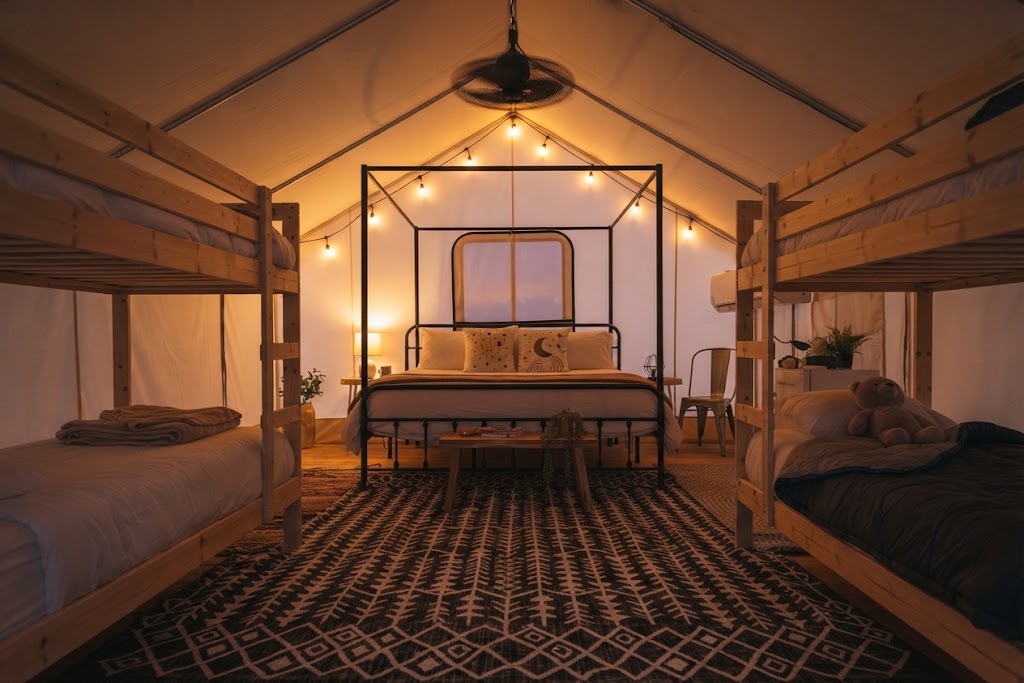
- Bell tent pitched, guyed and furnished before you arrive
- Real beds — a double, sometimes plus singles or futons
- Bedding included or available to hire
- Rugs or matting over the groundsheet
- Battery lanterns and fairy lights; mains power is rare
- A small table and seating, or crates and cushions
- Fire pit outside, often with a grill, and firewood for sale
- Shared shower and toilet block, standard varies enormously
- Camp kitchen with sinks, sometimes a fridge and a kettle
- Occasionally a wood burner inside, at higher-end sites
Facilities comparison against pods and standard camping: bell tent sites usually have better facilities than a basic campsite, because the operator is charging glamping prices and knows it. They almost never have facilities as good as a pod site, because pod sites carry a year-round revenue stream to pay for them.
Unique features of bell tent accommodation worth mentioning: the acoustics, which are soft and pleasant; the light, which is diffuse and golden through cotton canvas; the temperature behaviour, which is cool in the day and cold at night; and the sheer visual appeal, which is why bell tents dominate glamping photography out of all proportion to their market share.
Cost and Booking Information
Average costs:
| Tent | Sleeps | May & Sep | Jun | Jul–Aug | Per head, full |
|---|---|---|---|---|---|
| 4m bell tent | 2–3 | £70–£85 | £80–£95 | £95–£115 | £32–£38 |
| 5m bell tent | 3–4 | £80–£100 | £95–£115 | £110–£130 | £28–£33 |
| 6m bell tent | 4–5 | £95–£115 | £110–£130 | £125–£150 | £25–£30 |
| With wood burner | — | +£15–£25 | +£15–£25 | +£15–£25 | — |
The booking process is straightforward and mostly online, because bell tent operators run more units than a single-hut farm does and need a system. Deposits of 25 to 30% are usual, with the balance a fortnight or so before arrival. Minimum stays are shorter than for pods — two nights in peak, often one night midweek.
Finding deals and discounts:
- May and September are 20–30% cheaper than August with barely worse weather.
- Midweek nights are meaningfully cheaper and more available.
- Multi-tent group bookings frequently unlock a per-tent discount. Ask.
- Bring your own bedding where permitted — saves £15 to £30 a head.
- Late availability appears more often than for pods, because canvas sites carry spare capacity.
If the price is the main attraction, compare with the options in cheap Lake District glamping and cheap camping pods.
Activities and Experiences
Outdoor Activities in the Lake District
Bell tent stays live or die on what you do during the day, since you will not be spending much time inside.
- Fell walking. Catbells above Derwentwater, Hallin Fell above Ullswater, the Old Man of Coniston, Scafell Pike if you want the highest.
- Wild swimming. Crummock Water, Rydal Water, Coniston Water, Derwentwater at Calfclose Bay. Bell tent season coincides exactly with swimmable water.
- Paddleboarding and kayaking. Hire is widespread from May to September on all the main lakes.
- Mountain biking. Grizedale and Whinlatter, both waymarked, both with hire.
- Ghyll scrambling. Stickle Ghyll in Langdale, guided sessions widely available.
- Steamer trips. Ullswater and Windermere, and useful as one-way transport.
- Sitting by a fire pit. Genuinely one of the main activities, and the reason people book canvas.
Inside the Lake District National Park there are roughly a thousand kilometres of public rights of way, extensive open access land, and free ranger-led walks in season. The park authority publishes route guides and parking information at no cost, which is worth using because the popular trailheads fill by nine on summer mornings.
How the activities complement bell tent camping specifically: you get properly tired, you eat outside, and a canvas tent at ten at night after seven hours on the fells is exactly enough accommodation. The format punishes people who plan to stay in and read.
Best Time to Visit for Bell Tent Camping
Season, honestly assessed:
- May. Good. Driest month statistically, long evenings, cool nights, low prices. Bring a warm sleeping bag.
- June. The best month. Longest days, water warming, prices not yet at peak, midges not yet at their worst.
- July–August. Warmest nights and highest prices. Busy, and thunderstorms are a feature.
- September. Very good in the first half, cooling fast in the second. Prices drop from mid-month.
- April and October. Only with a stove. Otherwise the nights are genuinely unpleasant.
- November–March. Closed. Book a pod.
Weather effects on canvas are worth understanding before you book. Rain is fine — cotton canvas swells and seals, and the sound is pleasant. Wind is more of an issue, since a single-pole tent flexes noticeably. Heat is a real problem: a bell tent in direct August sun becomes uncomfortable by ten in the morning, so a pitch with afternoon shade is worth asking for. And condensation forms on the inner canvas on still, humid nights, which surprises people who expected canvas to be immune.
Seasonal events worth planning around: the Keswick Mountain Festival in May, Ambleside and Grasmere sports in the summer, Cartmel racing through the season, and Kendal Mountain Festival in November. Visit Lake District publishes the calendar.
Comparing Accommodation Options
Bell Tents vs. Other Accommodations
Against traditional camping, a bell tent gives you a real bed, a pitched tent and standing room for roughly three times the pitch fee. What you lose is the flexibility to pitch somewhere quieter, and the ability to camp in April.
The luxury aspect of bell tent glamping is real but shallow. Rugs, lanterns, bunting and a proper mattress transform how a tent feels without changing what it is. There is no bathroom, no heat at most sites, no power and no lock. Anyone describing a bell tent as luxury accommodation is using the word loosely.
| Option | Peak rate | Sleeps | Season | Main strength | Main weakness |
|---|---|---|---|---|---|
| Bell tent | £95–£150 | 2–5 | May–Sep | Cheapest, best atmosphere | Cold, no bathroom, no lock |
| Yurt | £165–£220 | 4–6 | Apr–Oct | Space plus a wood burner | No sound privacy |
| Safari tent | £170–£290 | 6–8 | Apr–Oct | Bedrooms and a kitchen | Seasonal, expensive up front |
| Glamping pod | £125–£240 | 2–4 | Year round | Weatherproof, powered, locks | Tiny |
| Shepherd's hut | £165–£260 | 2 | Year round | Log burner, romance | Two people only, very small |
Our honest recommendation. Book a bell tent if you are travelling in June, July or August, on a budget, with a group or with children, and you intend to be outside all day. Book a pod instead if you are travelling outside those months, if anyone in the party needs a bathroom nearby, or if a run of wet days would ruin the trip. In the right week a bell tent at £110 is better value than anything else in Cumbria; in the wrong week it is the worst decision on this whole website.
Questions people ask
What is a bell tent?
A single-pole canvas tent shaped like a cone, usually 4 to 6 metres in diameter, with a circular groundsheet and guy ropes around the perimeter. The design comes from the nineteenth-century military Sibley tent. Glamping versions arrive pitched and furnished with real beds, rugs and lighting.
How much does bell tent glamping cost in the Lake District?
£75 to £130 a night for two to five people, which makes it the cheapest glamping in Cumbria. A 5m tent sleeping four at £110 works out at under £28 a head.
Are bell tents warm at night?
Not especially. Canvas has essentially no insulation and most sites do not fit stoves. In July that is fine. In late September you will want a proper sleeping bag and a hat. Sites that do fit a stove charge more and are worth it.
Can you hire a bell tent and pitch it yourself?
Some Cumbrian operators offer pitch-and-collect hire for events and private land, and a few campsites let you bring your own bell tent onto a standard pitch. Most glamping bookings, though, are for a tent already pitched and furnished on the operator's site.
Is bell tent camping suitable for children?
Very. Children generally love bell tents more than any other glamping format — the space feels like a den, there is a fire pit outside, and other children are usually nearby. The limits are cold nights and the walk to the toilet.