Safari tents
Discover Safari Tents in the Lake District: A Unique Glamping Experience
The family answer. Separate bedrooms, a real kitchen, a deck big enough for eight, and the best cost per head in Lakeland glamping — for six months of the year.
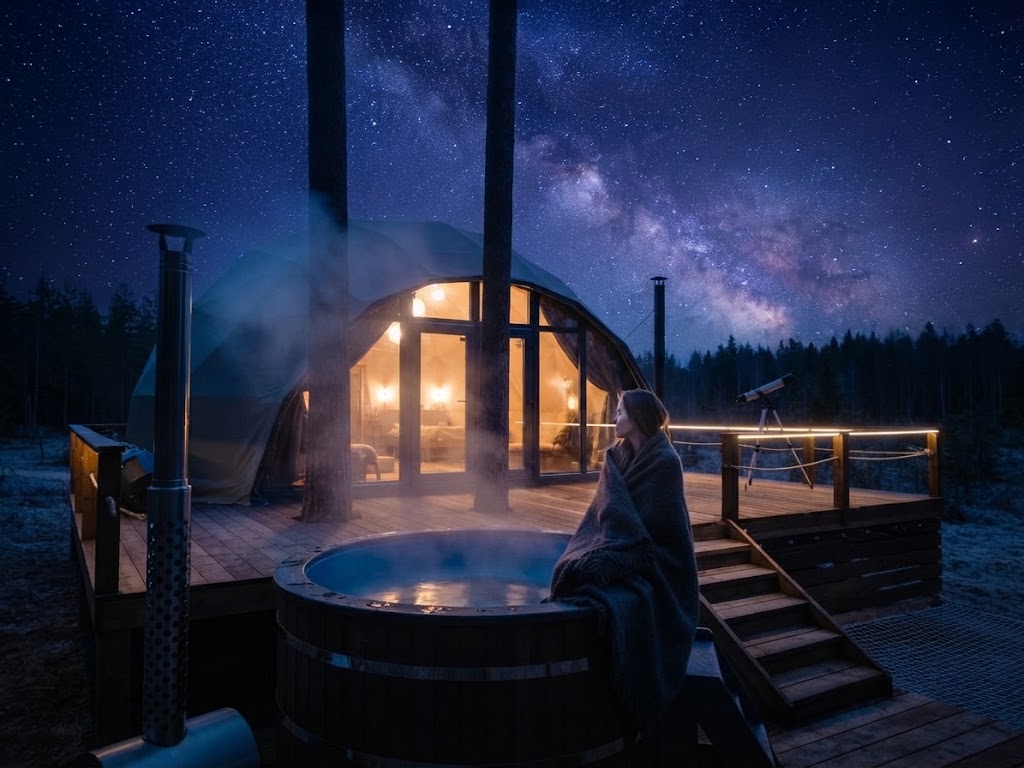
TL;DR
- A safari tent is 35–55 square metres of canvas on a timber deck, with two or three bedrooms, a kitchen and a wood burner.
- Sleeps six to eight at £170–£290 a night, so £28–£40 per head. The best value in Cumbrian glamping.
- Ensuite safari tents exist and cost £40–£70 more. With children, buy it.
- Supply concentrates in the North Lakes around Ullswater and Penrith, plus the southern lakes.
- Season is April to October. WiFi is patchy and usually only at the reception building.
Exploring Safari Tents in the Lake District
Where to Find Safari Tents in the Lake District
The Lake District suits safari tents for a straightforward commercial reason: it receives 15 to 18 million visitors a year, a large share of them families, and a family of six cannot fit in a glamping pod. Safari tents fill that gap better than anything else available inside a national park where new permanent building is heavily restricted.
Supply concentrates in two broad areas.
The North Lakes — the country around Ullswater, Penrith, Pooley Bridge and the eastern approaches to Keswick — carries the highest density. There are practical reasons. The land is gentler and flatter than the central valleys, so a raised deck is easier to build. Access from the M6 at junction 40 is quick. And the rainfall is materially lower than in Borrowdale or Langdale, which matters when your accommodation is made of fabric.
The southern lakes — the Lyth and Winster valleys, Cartmel Fell, the country between Windermere and Morecambe Bay — forms the second cluster, with a milder climate and better food nearby.
Ullswater Heights is representative of the North Lakes model: an established site in the Ullswater catchment offering safari tents alongside other accommodation, positioned to give families access to the lake, the steamer, Aira Force and the Helvellyn range without being in the middle of the busiest valleys. Sites of this type typically run six to twenty units, with a facilities block, a play area and hard-surfaced internal roads.
| Area | Supply | Rate, peak | Nearby |
|---|---|---|---|
| Ullswater & Pooley Bridge | High | £220–£290 | Steamer, Aira Force, Helvellyn, Lowther Castle |
| Penrith & Eden Valley | High | £190–£260 | M6, mainline station, drier weather |
| Lyth & Winster valleys | Moderate | £200–£270 | Kendal, Cartmel, Scout Scar |
| Coniston & Grizedale | Moderate | £190–£250 | Bike trails, Coniston Water, Brantwood |
| Windermere fringe | Low | £230–£310 | Cruises, restaurants, train |
| Central and western valleys | Very low | — | Too wet, too steep, too remote |
Types of Safari Tents Available
The category divides into three recognisable specifications.
Family safari tents are the volume product. Around 35 to 45 square metres, two bedrooms plus a sofa bed, a kitchen with a sink and gas hob, a wood burner, a dining table inside and another on the deck. Sleeping six is comfortable, seven is possible. Facilities are usually shared. Rates run £170 to £250.
Features that make them work for families:
- Children get their own room with a door, or at least a partition
- Enough floor space that a rainy afternoon is survivable
- A kitchen, so you are not cooking six meals on a camp stove
- A deck that keeps most of the mud outside
- Beds already made up, which matters after a four-hour drive
Luxury safari tents sit at 45 to 55 square metres with three bedrooms, an ensuite bathroom, a better kitchen — sometimes with an oven — proper furniture rather than camping chairs, and occasionally a private hot tub on the deck. Rates run £240 to £340, and with a tub up to £400.
Compact or two-bedroom tents occupy the bottom of the range at 28 to 35 square metres, sleeping four to five, shared facilities, simpler fit-out. £150 to £200. A good option for a family of four who want space without paying for a bedroom they will not use.
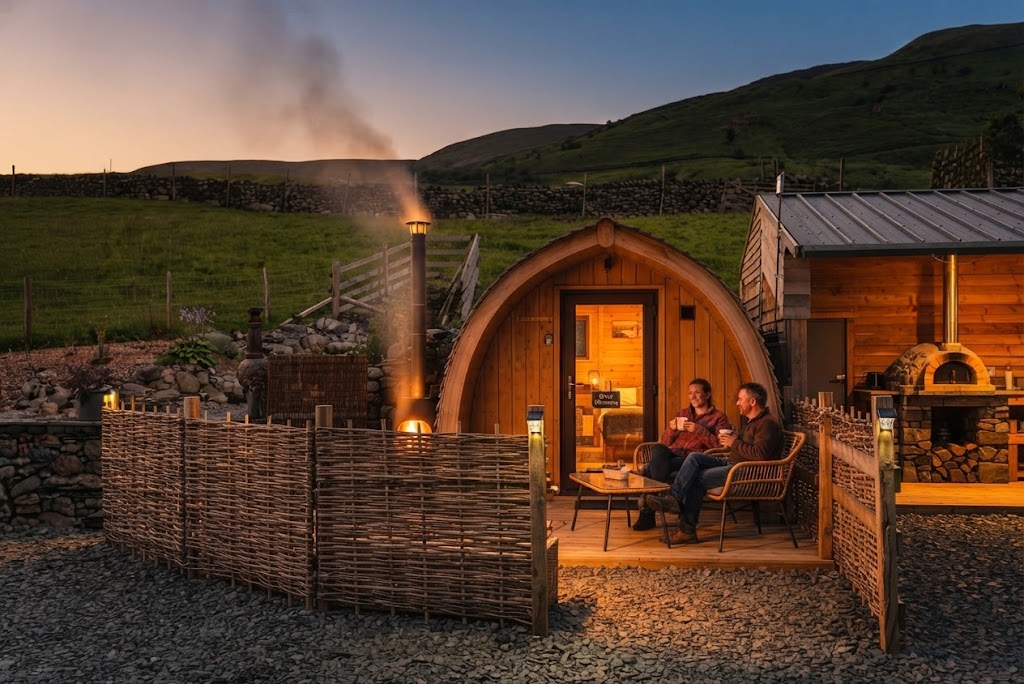
Amenities and Features of Safari Tents
Ensuite Facilities in Safari Tents
An ensuite safari tent has a partitioned bathroom inside the canvas envelope, with a shower, WC and basin plumbed to the site's water and drainage. It occupies roughly four to six square metres, so an ensuite tent is either slightly larger overall or slightly tighter in the living area.
Why it matters more here than in most accommodation: the alternative is a walk across a field at 2am with a child who needs the toilet urgently, in Cumbrian rain, in the dark. Every parent who has done that once pays for the ensuite the second time.
| Standard, shared facilities | Ensuite | Luxury ensuite | |
|---|---|---|---|
| Bathroom | Shared block, 20–80m away | Shower and WC inside | Shower and WC, better fittings |
| Bedrooms | 2, plus sofa bed | 2–3 | 3 |
| Kitchen | Sink, gas hob, fridge | Sink, hob, fridge | Plus oven, sometimes dishwasher |
| Hot water | At the block | Plumbed to the tent | Plumbed, better pressure |
| Sleeps | 6–7 | 6–8 | 6–8 |
| Peak rate | £170–£250 | £220–£300 | £280–£400 |
| Per head at full occupancy | £28–£36 | £31–£43 | £40–£50 |
Luxury ensuite safari tents add fittings rather than function: a shower with real pressure, heated towel rails at a few sites, better bedding, an oven. Whether that is worth another £60 to £100 a night depends on how long you are staying and whether you plan to cook properly. For a week, probably yes. For two nights, no.
Connectivity: WiFi Availability
WiFi has moved from luxury to expectation, and Cumbria has not entirely kept up. That is a geography problem rather than a will problem: fibre reaches the towns, not the valley-floor fields, and mobile coverage behind a 600-metre fell is whatever the physics allows.
What you will actually find:
- WiFi at the reception or facilities building. The most common arrangement. Usable, involves walking there.
- Site-wide WiFi. Increasingly offered, frequently slow, and contended in August when forty people stream at once.
- In-tent WiFi. Rare. Where it exists, the site advertises it prominently.
- Nothing. Still common at farm-based sites, and sometimes deliberate.
Mobile coverage varies enormously by valley. Ullswater and the Eden Valley are reasonable. Borrowdale, Wasdale and Langdale are patchy to absent. Do not assume you can look up a walk when you get there.
How connectivity actually improves a glamping stay, when it works: checking the Met Office mountain forecast before committing to a summit, booking a steamer, finding out whether the pub is doing food, and letting teenagers cope. That is a real list, not a trivial one. Our practical advice is to download maps and forecasts before you arrive, take a power bank, and treat any WiFi you find as a bonus.
Family and Luxury Glamping Options
Family-Friendly Safari Tents
What makes safari tents suit families better than any other glamping format:
- Separate bedrooms. Children go to bed at eight and adults do not have to.
- Floor space. Forty square metres absorbs a wet afternoon in a way that fifteen does not.
- A kitchen. Fussy eaters, allergies and toddler mealtimes all become manageable.
- A deck. Boots off, mud outside, one clear boundary that children understand.
- Cost per head. £28 to £40 per person is cheaper than almost any alternative.
- Other children. Safari tent sites are family sites. Yours will find friends by teatime.
Activities and amenities for families in the Lake District, from a safari tent base:
- Ullswater Steamers, which children like more than they expect to. Combine with the Aira Force waterfall walk.
- Derwentwater launches and the Keswick–Catbells combination for a first real fell.
- Grizedale Forest, waymarked bike trails, sculpture trail and Go Ape.
- Lowther Castle, near Penrith, with one of the best adventure playgrounds in northern England.
- Honister Slate Mine for the mine tour, and the via ferrata for older children.
- Rydal Water and Derwentwater beaches for swimming and stone-skimming.
- The Lakeside and Haverthwaite Railway, steam, and it connects to a Windermere cruise.
Safety and comfort with children in a canvas tent: check where the wood burner guard is and whether there is one, since a lit stove in a room with a three-year-old needs thinking about. Confirm the distance to the facilities block. Ask whether internal roads carry cars. Bring a night light, because canvas is very dark once the stove dies. And bring more layers than the forecast suggests, because canvas cools fast after midnight.
Luxury Safari Tent Options
Luxury safari tents are the top of Lakeland canvas: 45 to 55 square metres, three bedrooms, ensuite bathroom, kitchen with an oven, real furniture, a deck with proper seating, and at some sites a private hot tub.
What separates them from a standard family tent:
| Standard | Luxury | |
|---|---|---|
| Size | 35–45m² | 45–55m² |
| Bedrooms | 2 plus sofa bed | 3, doors on all of them |
| Bathroom | Shared or basic ensuite | Proper ensuite, decent pressure |
| Cooking | Two-ring gas hob | Hob and oven, sometimes a dishwasher |
| Furniture | Functional | Sofas, rugs, lamps |
| Hot tub | No | Sometimes, on the deck |
| Units on site | 8–20 | 3–8 |
| Peak rate | £170–£250 | £280–£400 |
The unique experiences at this level are mostly about not compromising. You can cook a proper meal for eight. Everyone showers without queueing. There is a sofa. For a multi-generational trip — grandparents, parents, children — a luxury safari tent does something no other glamping format manages, which is house all of them comfortably in one place. See also luxury camping in the Lake District.
Booking Your Safari Tent Experience
Safari Tents at Ullswater Heights
Ullswater Heights sits in the North Lakes, in the Ullswater catchment near the eastern side of the national park. As a glamping destination the position does several useful things at once: it puts you close to the second-largest lake in the district, on the drier side of the fells, and within easy reach of the M6 and Penrith station.
What a site in this position offers:
- Ullswater at close range — the steamer between Glenridding, Howtown and Pooley Bridge, and the best shoreline walk in the park along the eastern bank
- Aira Force, the National Trust waterfall, twenty minutes away
- Helvellyn and the eastern fells for serious walking
- Hallin Fell, forty minutes up for a wildly disproportionate view
- Lowther Castle and Penrith for wet days and supplies
- Lower rainfall than the central and western valleys
Accommodation at North Lakes sites of this type typically includes family safari tents and ensuite options alongside other unit types, with a facilities block, laundry and often a small shop. Booking runs through the site's own system, and school holidays go first — four to six months ahead for late July and August is realistic.
How to Book a Safari Tent in the Lake District
Steps:
- Count your party and pick the size. Do not book a "sleeps eight" for eight adults without checking the layout.
- Decide on ensuite. With children under ten, treat it as compulsory.
- Check the open season. April to October is standard, and some sites are shorter.
- Confirm what is included: bedding, towels, firewood, gas, cot or high chair.
- Ask about the deck and the aspect. A deck facing north-east never gets evening sun.
- Check facilities distance if you are not booking ensuite.
- Book direct, read the cancellation terms, and diarise the balance date.
Finding the best deals and availability:
- Late April, May, early June, September and October all run 20–35% below peak.
- Sunday-to-Friday blocks are cheaper and far more available than Friday-to-Sunday.
- Watch the seven-to-fourteen-day window for cancellations, especially in shoulder season.
- Ask about the sixth and seventh nights on a week-long booking.
- Two families sharing one large tent beats two smaller tents on cost, if you can stand each other.
Considerations when choosing between tents: bedroom count over total floor area, ensuite over kitchen fittings, deck aspect over view, and unit count on site over everything else if quiet matters to you. A luxury tent on a twenty-unit site in August is a busy holiday whatever the specification says.
Questions people ask
What is a safari tent?
A large lodge-style tent, canvas over a timber frame, pitched on a raised wooden deck. Internal partition walls create two or three bedrooms plus a living area, and there is normally a kitchen with a sink, gas hob and fridge, and a wood burner for heat. Think of it as a canvas holiday cottage.
How many people does a safari tent sleep?
Six to eight. A typical layout is one double bedroom, one twin, and either a bunk room or a sofa bed in the living space. That makes them the natural choice for a family of five or six, or two couples with children.
Do safari tents have ensuite bathrooms?
Some do — a partitioned shower room and WC inside the tent, with hot water plumbed in. It adds roughly £40 to £70 a night. The alternative is a shared block, which with young children at 2am is a meaningfully worse experience.
Is there WiFi at Lake District safari tent sites?
Usually at the reception or facilities building, rarely inside the tent. Mobile signal in many Cumbrian valleys is poor to nonexistent. If you need to work, verify it specifically rather than trusting a WiFi icon on a listing.
When are safari tents open in the Lake District?
Roughly the start of April to the end of October, with a few sites running mid-March to early November. Canvas comes down for winter to protect the fabric. For a winter stay, book a pod or a shepherd's hut instead.