Trip planning
Experience Glamping in the Stunning Lake District, UK
Less about what glamping is, more about how to build a week around it. Amenities that matter, water you can swim in, and why Keswick keeps winning as a base.
TL;DR
- Keswick works as the strongest all-round glamping base — Derwentwater, three big fell groups and a proper town, all walkable.
- Hot tubs, wood burners and made-up beds are the three amenities worth paying for. Everything else is decoration.
- Wild swimming sits within a mile of a surprising number of sites. Crummock Water and Ullswater's eastern shore are the pick.
- Visit Lake District publishes the events calendar and travel information you actually need before booking.
- Best weeks of the year: mid-May to mid-June, then the second half of September.
Introduction to Glamping in the Lake District
Why Choose the Lake District for Glamping?
The Lake District compresses an unusual amount of landscape into 2,362 square kilometres. Sixteen lakes, 214 Wainwright fells, one summit above 950 metres, and a road network that was never designed for any of it. That density is exactly why glamping works here: you sleep in the middle of the thing you came to see, and you skip the twenty-minute drive from a hotel car park.
Cumbria also has the accommodation supply. Farm diversification across the national park has produced hundreds of small glamping operations, most of them one to six units on land that used to graze Herdwicks. Planning policy inside a national park favours small and low-impact, which is why you find single pods behind hedgerows rather than resorts.
The benefits stack up in a way hotels cannot match:
- You wake up already outside. No lobby, no breakfast service, no queue for the car park at 8am.
- Dogs come as standard at most sites, for a modest fee.
- Self-catering means you eat when you get down off the hill, not when the kitchen decides.
- Two people can have a private hot tub for the price of a mid-range hotel room.
- Sites sit in places a hotel could never get planning permission for.
The honest counterweight: space is tight, storage is minimal, and in November you will be putting wet boots somewhere awkward.
Top Glamping Sites in the Lake District
Eden Heights Glamping operates on the eastern edge, in the Eden Valley near Penrith. Its main structural advantage is meteorological. The Eden Valley sits in the rain shadow of the central fells and records roughly a third of Borrowdale's annual rainfall. If your holiday depends on sitting outside, that statistic matters more than any amenity list.
Beyond Eden Heights, the operators that recur in Lakeland glamping conversations divide into four groups:
| Type of operator | Units | Typical rate | What you get |
|---|---|---|---|
| Farm diversification, single owner | 1–6 | £110–£260 | Personality, quiet, patchy websites, best value |
| Campsite with a pod field | 8–30 | £95–£160 | Facilities blocks, shop, families, noise |
| Multi-site brands | Many | £120–£220 | Consistency, booking systems, less character |
| Curated, design-led | 1–4 | £220–£450 | Architecture, styling, a photographer's dream |
We look at individual operators, including the multi-site names, in our site reviews section. The Eden Heights page goes further on that one.
Amenities and Features of Lake District Glamping
Luxurious Amenities: Hot Tubs and More
Amenity lists in glamping listings are padded. Strip out the marketing and three things change your holiday materially:
- A made-up bed. Arriving to a duvet rather than a bare mattress is worth £40 a night of anyone's money.
- A private bathroom. The gap between an en-suite pod and a shared block is the gap between a holiday and a camping trip.
- Heat you control. A wood burner or a decent electric heater turns October into a viable month.
Then there is the hot tub. A private hot tub is the most requested amenity in Lake District glamping and the one that raises the nightly rate hardest — typically by £60 to £110. Its popularity is not irrational. Hot water at 38°C after a day on the fells does measurable work on tired legs, and a tub is the only outdoor activity that gets better in the rain.
Two distinctions the listings blur:
- Wood-fired against electric. Wood-fired tubs are romantic, cheap to run and slow — two to three hours to temperature. Electric tubs are instant, jetted, and rely on the site keeping the chemistry right.
- Private against shared. A tub on a booking rota shared with five other pods is a different product. Sites offering this rarely lead with it.
Secondary amenities that genuinely earn their place: a fridge, a covered outdoor cooking area, a fire pit with firewood included, decent blackout, and a kettle that does not trip the socket. Our hot tub guide handles the whole subject properly.
Types of Glamping Accommodations
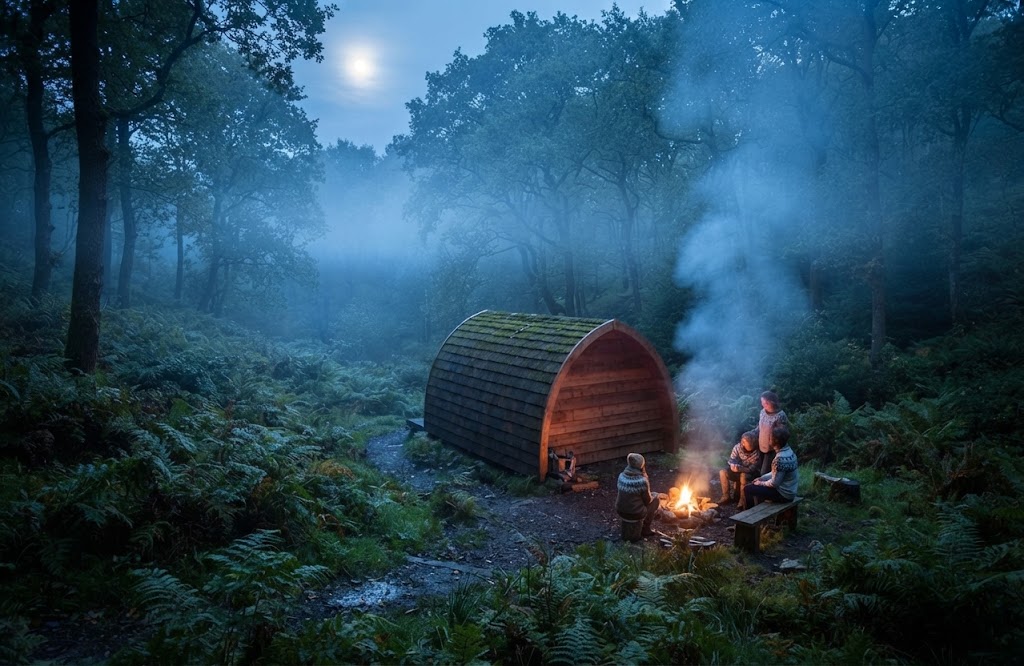
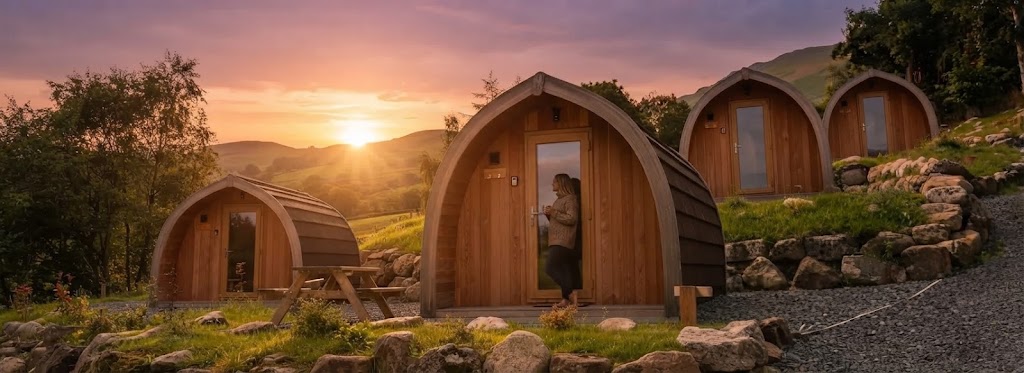
Glamping pods are the Lake District default, and they earn the position. A pod is a curved insulated timber shell, usually 3m by 5m, with a mattress at one end and a door with a view at the other. Insulation buys a year-round season. Timber makes Cumbrian rain a non-event.
| Type | Weatherproof | Season | Floor space | Sleeps | Heat source |
|---|---|---|---|---|---|
| Glamping pod | Excellent | Year round | 12–18m² | 2–4 | Electric |
| Shepherd's hut | Excellent | Year round | 10–14m² | 2 | Wood burner |
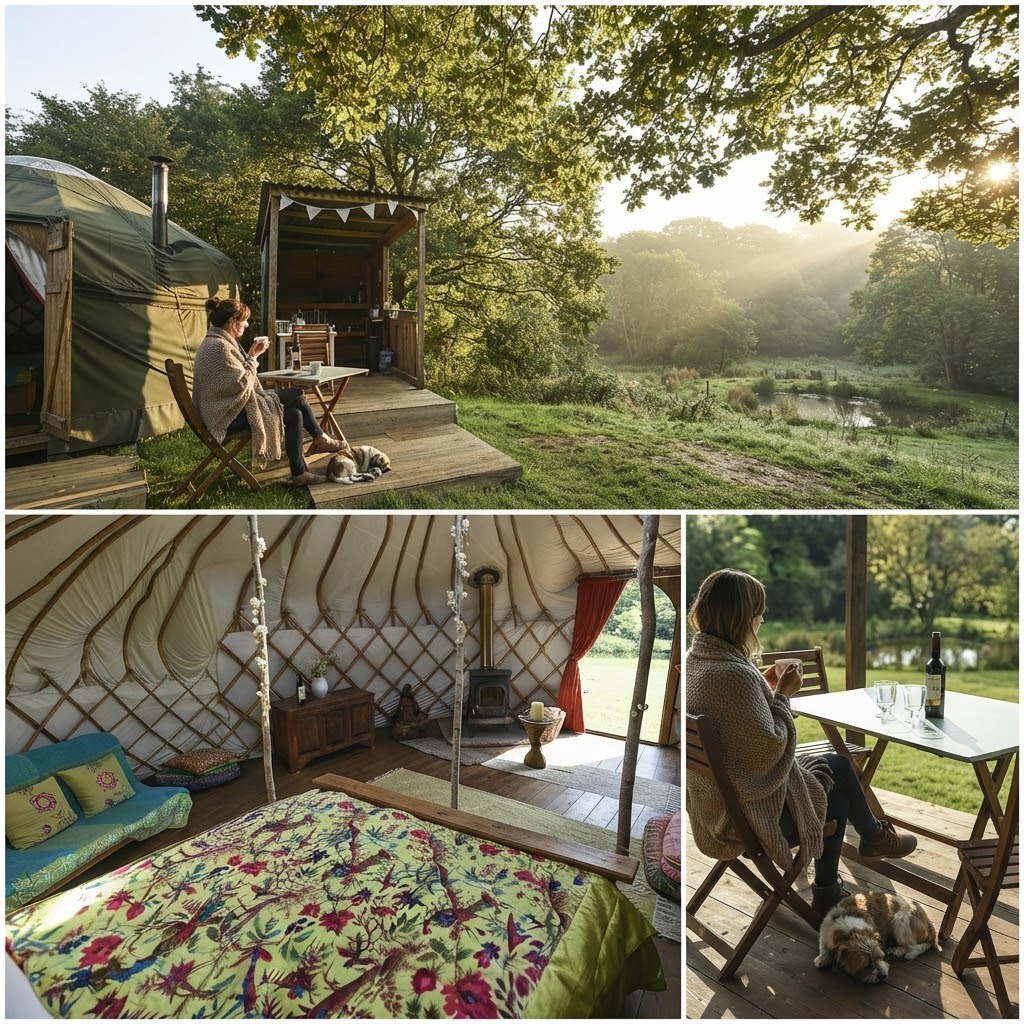
| Yurt | Good | Apr–Oct | 20–38m² | 4–6 | Wood burner |
| Safari tent | Good | Apr–Oct | 35–55m² | 6–8 | Wood burner |
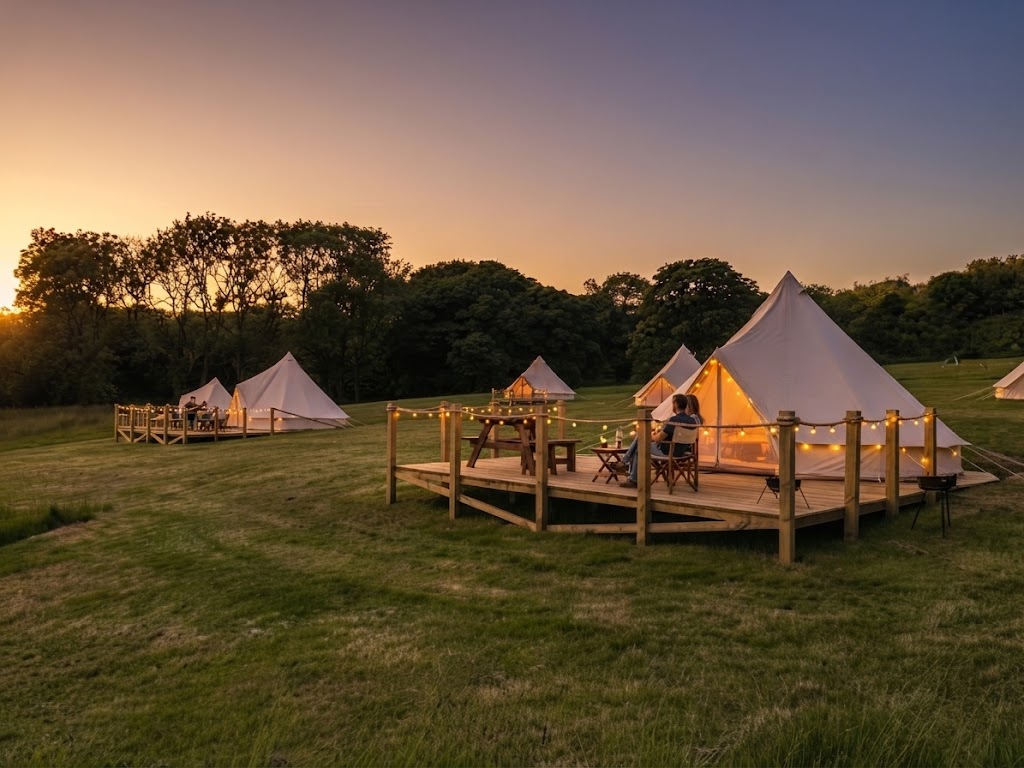
| Bell tent | Fair | May–Sep | 12–19m² | 2–5 | None, usually |
Pods win on reliability and lose on space. A yurt gives you three times the floor area and a stove you can stand beside, but it closes for winter and the acoustic privacy is nil. Safari tents are the family answer: separate bedrooms, an actual kitchen, and a deck big enough for eight people to eat on. Full breakdown in our huts, yurts and tents section.
Activities and Attractions Near Glamping Sites
Explore Wild Swimming Spots
Wild swimming spots sit close to most glamping sites for the obvious geological reason: water collects at the bottom of valleys and glamping sites occupy the sides. A short walk usually gets you in.
| Water | Entry | August temp | Nearest glamping cluster | Notes |
|---|---|---|---|---|
| Crummock Water | Shingle, gradual | 15–17°C | Buttermere valley | The best of them. Deep, clear, quiet |
| Ullswater, eastern shore | Shallow, easy | 16–18°C | Pooley Bridge, Howtown | Steamer lets you swim one way and boat back |
| Derwentwater, Calfclose Bay | Beach | 16–18°C | Keswick, Borrowdale | Busy, islands to swim to, ten minutes from town |
| Rydal Water | Grassy, sudden drop | 17–19°C | Ambleside, Grasmere | Warmest, smallest, most crowded |
| Coniston Water | Shingle | 16–18°C | Coniston, Torver | Long and flat, good for distance |
| Blea Tarn, Langdale | Rock | 13–15°C | Great Langdale | High, tiny, freezing, worth the walk |
The appeal is chemical as much as scenic. Cold immersion triggers a catecholamine response — the natural highs people chase and then describe badly at dinner. Twenty seconds of genuine shock, then forty minutes of feeling superb.
Treat it seriously. Cold water shock affects strong swimmers, so enter slowly and let your breathing settle before you commit. Never swim alone, never after drinking, and check for blue-green algae warnings in late summer. Thirlmere and Haweswater are working reservoirs with restrictions. The Outdoor Swimming Society and RNLI both publish free guidance.
Visit Keswick: A Hub for Glampers
Keswick sits at the northern end of Derwentwater with a population of about 5,000 and the highest concentration of outdoor shops per head in England. For glampers it functions as the practical centre of the park.
What Keswick gives you:
- Fells from the door. Latrigg takes an hour. Catbells is the finest short afternoon in the Lakes. Skiddaw at 931m is a half day. Blencathra sits behind it.
- Derwentwater. Launches run a circular service, so you can walk one shore and sail back. Calfclose Bay for the swim.
- Supplies. Booths and a Co-op for food, half a dozen gear shops for the waterproof you forgot, a Thursday and Saturday market.
- Wet-weather options. The Theatre by the Lake, the Pencil Museum for children who have hit their limit, the Puzzling Place.
- Food. Solid pub kitchens rather than fine dining. The Dog and Gun for goulash, the Pheasant at Bassenthwaite for something smarter, pizza if the children insist.
Glamping supply around Keswick and Borrowdale leans towards larger pod fields and campsite pods rather than boutique units with tubs. Rates run lower than the Eden Valley or the Windermere fringe. Trade the hot tub for the walk from your door.
Planning Your Glamping Trip
Best Times to Visit the Lake District
Cumbrian weather resists prediction. Visitor patterns and prices do not.
- Mid-May to mid-June. Our pick. Statistically the driest stretch, long evenings, rates about 15% below peak, water warming.
- Late June to August. Peak everything. Warmest water, busiest paths, highest prices, thundery afternoons. Book by February.
- Second half of September. The connoisseur's choice. Lake temperatures still hold from summer, crowds drop off after the first week, rates fall about 20%.
- October to March. Cheap, dark, often spectacular. Canvas closes. Pods with a heater are perfectly comfortable. Bring a head torch.
Visitor numbers to the national park sit somewhere around 15 to 18 million a year, and a large share arrive inside a six-week window. Anything you can do to travel outside it improves the trip.
Visit Lake District is the official destination management organisation and the most useful free planning resource: events calendar, road and travel updates, seasonal closures, accessible route information. Check it alongside the Met Office mountain forecast, which is materially better than a generic town forecast for anything above 400 metres.
Creating a Memorable Glamping Experience
A week that works, roughly:
| Day | Morning | Afternoon | Evening |
|---|---|---|---|
| 1 | Arrive, shop in Keswick | Latrigg for the view | Fire pit, pub kitchen |
| 2 | Catbells ridge | Launch back across Derwentwater | Hot tub, early night |
| 3 | Swim at Calfclose Bay | Castlerigg stone circle, Threlkeld | Cook at the pod |
| 4 | Drive to Buttermere | Crummock Water swim and circuit | Fish Inn, Buttermere |
| 5 | Wet-weather day: Theatre by the Lake, Pencil Museum | Grizedale Forest bike trails | Hot tub, wine |
| 6 | Scafell Pike from Wasdale, or Skiddaw | Recover | Anything with chips |
| 7 | Ullswater steamer, Aira Force | Pooley Bridge, Penrith market | Last fire |
Three habits make the difference. Shop once, properly, on arrival — village shops close at five and charge accordingly. Keep one day entirely unplanned for whatever the weather offers. And do the hard walk on day three or four, not day one, when your legs are still office legs.
For a first Lake District glamping trip the combination we would choose is a pod or hut with a private tub, a Keswick or Ullswater base, five nights in late May, and a rule that nobody looks at a screen after eight. Whether that means a standard pod, a luxury unit or something at the cheaper end depends on your budget, not on how good the holiday will be.
Questions people ask
Is Keswick or Windermere better for a glamping break?
Keswick if you walk. Windermere if you want the lake, the boats and easy train access. Keswick has the better gear shops and the shorter approach to serious fells; Windermere has more restaurants and worse traffic.
How far in advance should I book Lake District glamping?
Four to six months for July and August. Six to eight weeks for May, June or September. A week or less for January to March, when you can often negotiate a single night.
Are hot tubs at glamping sites cleaned between guests?
Reputable sites drain and refill between bookings, which is why many impose a changeover gap. Ask directly — the answer, and how fast it arrives, tells you what you need to know. Sites that dose chemically without draining should say so.
Can I get to a Lake District glamping site by train?
Some, yes. Windermere station sits on a branch line from Oxenholme. Penrith and Oxenholme are both on the West Coast Main Line. Beyond that you need a bus, a taxi or a lift from the owner — ask when booking, several will collect you.
What should I pack that I would not pack for a hotel?
Head torch, waterproof over-trousers, flip-flops for a shared shower block, a power bank, tea towel, matches, and a bag for wet clothes. Most sites supply nothing beyond bedding and a kettle.