Providers & reviews
Glamping in the Lake District: A Luxurious Outdoor Experience, Provider by Provider
The operator-focused view. Who runs what, how to read the ratings without being misled, and how availability and pricing actually behave through the year.
TL;DR
- Reviews are useful for operations, useless for scenery. Read for cleanliness, communication and noise; ignore anything about the view.
- Eden Heights Glamping is the drier-weather hot tub option. Inside Out Camping and Glamping is the cheaper canvas option.
- Pods and safari tents cover 90% of what you will be choosing between. Hot tubs decide the price.
- Availability collapses in February for the following August. Cancellations surface 7–14 days out.
- A five-star average from 40 reviews beats a five-star average from 6. Sample size matters more than score.
Introduction to Glamping in the Lake District
What is Glamping?
Glamping is luxury camping in the narrow sense: the shelter is built rather than pitched, so it comes insulated, wired and furnished. You bring food and clothes. The operator has already dealt with the bed, the heat and the roof.
The features that distinguish it from traditional camping are specific rather than vague:
- A permanent or semi-permanent structure, not a tent you erect
- A raised bed with a real mattress
- Mains electricity and lighting
- Controllable heat — electric panel, oil radiator or wood burner
- Furniture: table, chairs, storage, sometimes a kitchen
- A season that often runs all twelve months
Growth in the sector has been steep and it concentrates in scenic areas with strong existing tourism. The Lake District ticks both boxes hard. Farm incomes under pressure, planning policy that favours small low-impact development, and 15 to 18 million annual visitors have combined to produce hundreds of small glamping operations across Cumbria in barely fifteen years.
Why Choose the Lake District for Glamping?
England's largest national park covers 2,362 square kilometres of Cumbria and holds sixteen major lakes, 214 Wainwright fells and the country's highest ground at Scafell Pike, 978 metres. UNESCO inscribed it as a World Heritage Site in 2017 for the interaction of farming, industry and Romantic-era landscape ideas.
What makes it a prime glamping location, specifically:
- Variety within a small radius. Lake shore, valley floor, open fell, oak woodland and coastal marsh all sit inside a forty-minute drive.
- Activity density. Walking, swimming, sailing, kayaking, mountain biking, ghyll scrambling, rock climbing, fell running.
- Weather that rewards good accommodation. An insulated pod with a heater turns a wet week into a good one. A tent does not.
- Supply. Hundreds of small sites means genuine choice at every price point.
- Access. Two West Coast Main Line stations and the M6 along the eastern edge.
The landscapes divide roughly into five characters: the high central fells around Langdale and Borrowdale, the northern fells behind Keswick, the western valleys of Wasdale and Ennerdale, the softer southern lakes around Windermere and Coniston, and the drier eastern farmland of the Eden Valley. Glamping supply is thinnest in the west and thickest in the south and east.
Exploring Glamping Accommodations
Types of Glamping Accommodations
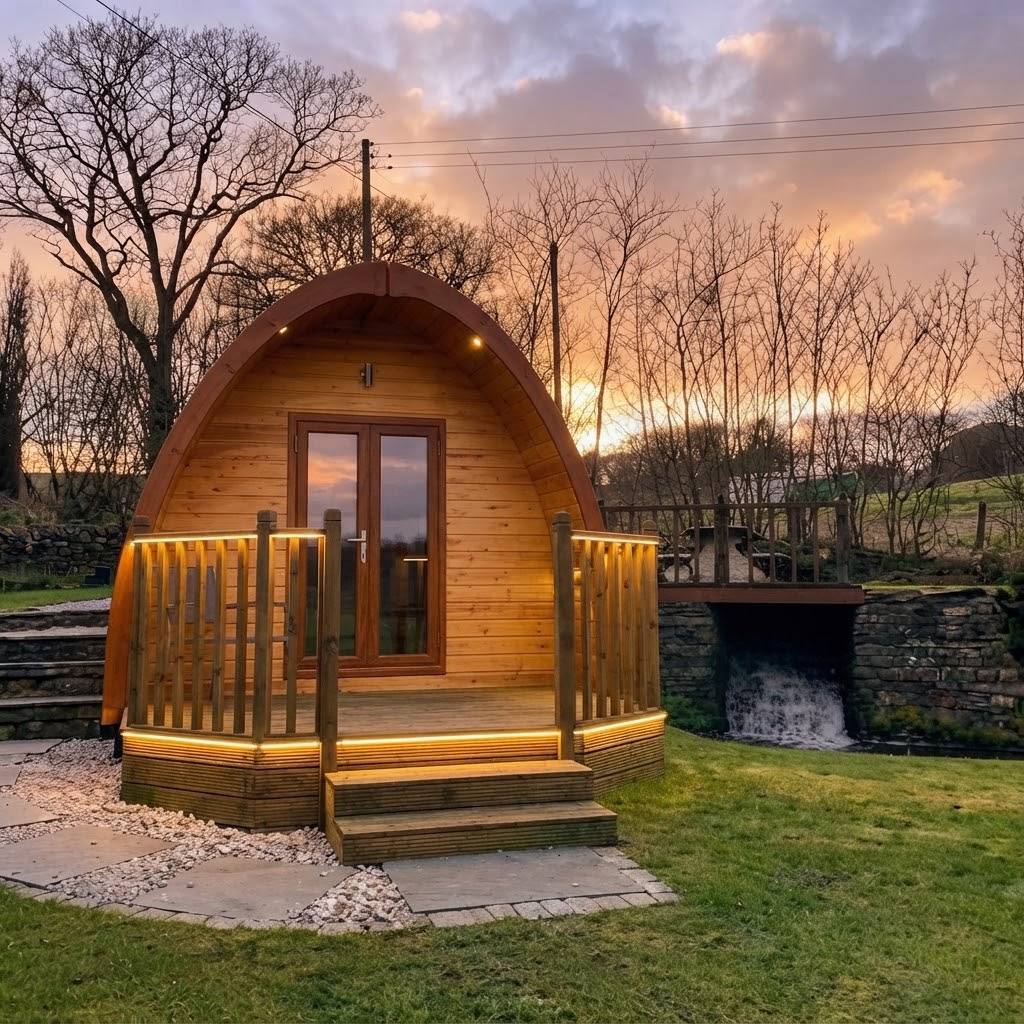
Glamping pods dominate Cumbria. A pod is a curved insulated timber shell, roughly 3m by 5m, engineered to shed rain and wind. That shape is not styling — it is why pods work in a region where Seathwaite records about 3,300mm of rain a year.
Pod features, by tier:
| Tier | Rate | Bed | Bathroom | Kitchen | Heat |
|---|---|---|---|---|---|
| Basic | £95–£125 | Mattress, bring bedding | Shared block | None | Panel heater |
| Standard | £125–£160 | Made up | Shared block | Kettle, fridge, microwave | Panel heater |
| En-suite | £160–£240 | Made up, towels | Private shower and WC | Hob, fridge, sink | Thermostatic |
| Luxury with tub | £240–£400 | Made up, king | Private, sometimes underfloor heat | Full kitchenette | Thermostatic |
Safari tents appeal to a different customer entirely. Lodge-style canvas on a raised deck, 35 to 55 square metres, two or three partitioned bedrooms, a proper kitchen with a gas hob and fridge, a wood burner, and a deck that seats eight. Season runs April to October.
The benefit comparison comes down to two axes: floor space and season length. Pods win the season and lose the space. Safari tents win the space, the kitchen and the cost per head, and lose five months of the year. Yurts sit in between; shepherd's huts sit below both on space and above them on romance. See huts, yurts and tents for the full set.
Luxury Amenities: Hot Tubs and More
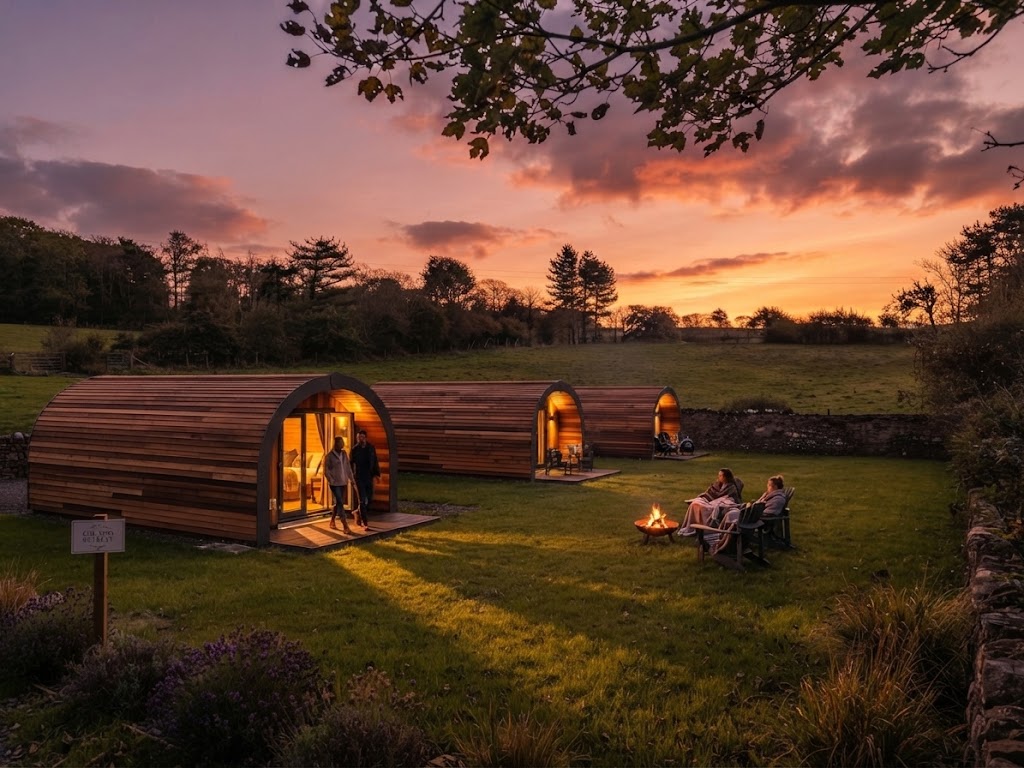
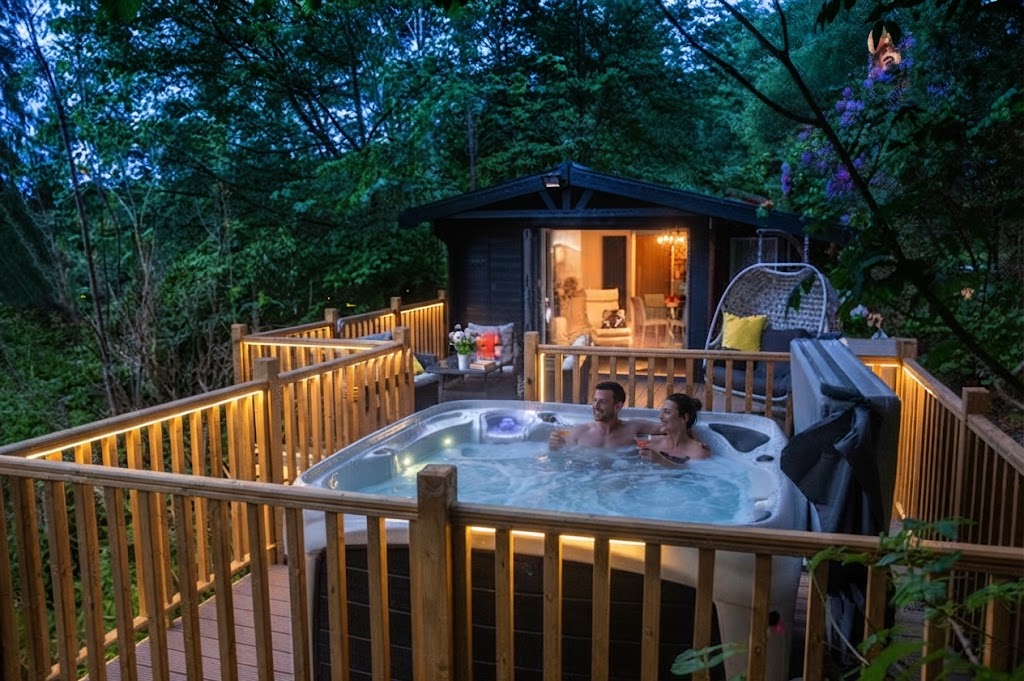
Private hot tubs appear at a minority of Lake District glamping sites and account for a disproportionate share of the searches. Sites offering them cluster in the Eden Valley, the Lyth Valley, the Cartmel peninsula and the Windermere fringe — places with the land area to give each tub genuine privacy.
Other amenities that shift the experience:
- Wood burner. Turns March and October into comfortable months. Ask whether logs are included.
- En-suite shower room. The single biggest quality-of-life upgrade in glamping.
- Covered outdoor kitchen. Because it will rain on at least one evening of any Lakeland stay.
- Fire pit with wood included. Small thing, disproportionate effect on the evening.
- Blackout blinds. Sunrise in June is before 5am. This matters more than people expect.
- Fridge. The difference between shopping once and shopping daily.
The value calculation depends on trip length and season. In August, a hot tub is a nice extra you use twice. In late October, it is the reason the evening works at all. Our hot tub page runs the numbers.
Top Glamping Providers in the Lake District
Eden Heights Glamping: A Premier Choice
Eden Heights Glamping operates in the Eden Valley on the eastern side of the national park, near Penrith. Its principal advantage is climatic. The Eden Valley lies in the rain shadow of the central fells and records roughly a third of Borrowdale's annual rainfall — in the region of 900 to 1,000mm against 2,000mm and more.
The offer is the small-site model: a handful of well-equipped units rather than a pod field, private hot tubs, decking, and views across farmland to the Pennines on one side and the Lakeland fells on the other. Penrith supplies a supermarket, a mainline station and M6 junction 40.
Feedback for glamping in this part of Cumbria consistently praises three things — the quiet, the space between units, and the number of dry evenings. The consistent reservation is distance: Ullswater is twenty to thirty minutes away and Keswick nearer forty. For a fell-heavy itinerary that mileage compounds. We look at the operator in more detail on the Eden Heights page.
Inside Out Camping and Glamping: A Unique Experience
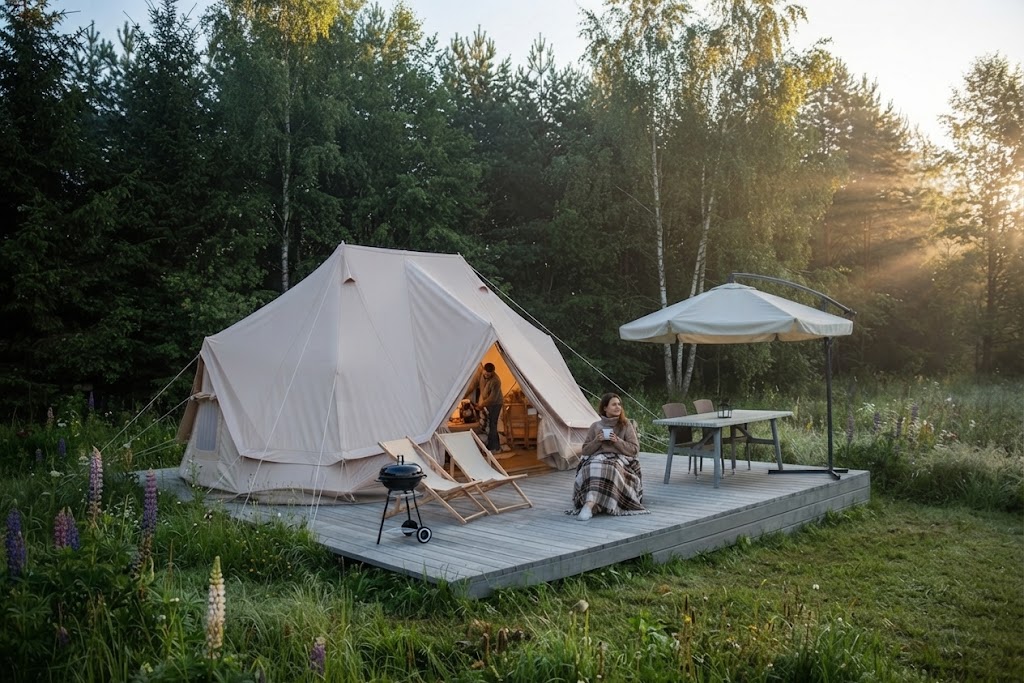
Inside Out Camping and Glamping occupies the canvas end of the market. The offer is bell tents and similar structures, furnished with beds and basic furniture, pitched for a season and taken down before winter. Shared shower and toilet facilities, fire pits, a field where people talk to each other.
What that buys you: a nightly rate well below any pod with a tub, an experience that is genuinely closer to being outdoors, and a season restricted to roughly May through September.
Guest feedback for canvas sites in Cumbria follows a predictable shape. High marks for atmosphere, value and the fire pit. Consistent complaints about cold mornings in shoulder season, the walk to the facilities, and rain noise for anyone who does not find it soothing. Nobody who books a bell tent should be surprised by any of that, and most are not. Related reading: bell tents in the Lake District.
Activities and Experiences in the Lake District
Outdoor Activities for Glampers
Lake activities and fell activities are the reason the accommodation only needs to be a base.
| Activity | Where | Half or full day | Weather |
|---|---|---|---|
| Fell walking | Catbells, Helvellyn, Scafell Pike, Old Man of Coniston | Both | Any, with the right kit |
| Wild swimming | Crummock Water, Ullswater, Derwentwater, Rydal Water | Half | Warm, calm |
| Kayak and paddleboard | Coniston, Derwentwater, Ullswater | Half | Low wind |
| Sailing | Windermere, Coniston, Bassenthwaite | Both | Some wind, obviously |
| Mountain biking | Grizedale, Whinlatter, Ennerdale | Both | Any |
| Ghyll scrambling | Stickle Ghyll, Church Beck | Half | Wet is better |
| Steamer trips | Ullswater, Windermere, Coniston | Half | Any |
| Houses and gardens | Hill Top, Dove Cottage, Brantwood, Blackwell | Half | Rain |
These complement glamping in a practical way. You come back muddy, wet and hungry, and a pod handles all three better than a hotel room does. Boots go outside. Waterproofs hang on the deck rail. Nobody minds.
Planning tips that save a day: check parking before you leave, because the popular trailheads fill by nine in summer. Use the steamers as one-way transport for linear walks. And keep one activity in reserve for the wet afternoon, because there will be one.
Planning Your Glamping Itinerary
Balance matters more than ambition. A workable five-night shape:
- Day one. Arrive, shop, short low-level walk. Do not attempt a summit on arrival day.
- Day two. A medium fell, four to six hours. Hot tub afterwards if you have one.
- Day three. Water day. Swim, paddle or sail. Half day, then nothing.
- Day four. The big walk, if the forecast allows. Otherwise a house, a garden and a long lunch.
- Day five. Something local and easy. Village, market, pub.
Visit Lake District publishes the events calendar, travel updates and accessible route guidance, and it is the fastest way to find out that the road you planned to use is closed. The National Park Authority covers parking, path repairs and ranger advice. Both are free and neither is trying to sell you anything.
Relaxation against adventure is the ratio to get right. Two hard days in five is plenty for most people. Glamping punishes over-scheduling, because there is nowhere comfortable to collapse indoors when it rains.
Practical Information for Glamping in the Lake District
Comparing Reviews and Ratings
Reviews are worth reading and worth discounting, in specific ways.
What reviews predict well:
- Cleanliness, especially of shared facilities
- Owner communication speed and tone
- Noise: neighbours, roads, livestock, generators
- Whether equipment actually works
- Accuracy of the listing against reality
What reviews predict badly:
- The view, which depends on cloud
- Whether it felt romantic, which depends on the couple
- Value, which depends on what the reviewer paid and when
- Weather, obviously, though people still mark sites down for it
Comparing Eden Heights against Inside Out Camping and Glamping through reviews is a category error, since they sell different products at different prices to different people. Compare within a category instead: canvas against canvas, tub pod against tub pod.
Three habits that improve how you read them. Sort by most recent, since ownership and standards change. Check the sample size — a 4.6 from 80 reviews is far more informative than a 5.0 from 6. And read the three-star reviews, which are almost always the honest ones.
Availability and Pricing
Availability in Lake District glamping behaves predictably enough to plan around.
| Travel period | Book by | Rate against peak | Single nights? |
|---|---|---|---|
| July–August | February | Peak | Almost never |
| Easter, half-terms | 3–4 months out | −5 to −10% | No |
| May–June | 6–8 weeks out | −15% | Occasionally, midweek |
| September | 4–6 weeks out | −20% | Yes, midweek |
| October–March | 1–3 weeks out | −35 to −45% | Yes, often negotiable |
Four factors set the price: season, private hot tub, en-suite bathroom, and length of stay. Weekend nights carry a £20 to £50 premium over midweek at the same site. Longer stays often unlock a discount that is never advertised, so ask about the fourth and fifth nights.
For securing a deal: ring rather than email if your dates are inside three weeks, since owners know their gaps better than their booking system does. Watch the seven-to-fourteen-day window for cancellations. And be flexible on the unit rather than the site — the pod without the tub at the same place is often free when the tub pod is not. More on this in last minute glamping and cheap camping pods.
Questions people ask
How reliable are glamping reviews?
Reliable on operations, unreliable on everything else. Cleanliness, communication, noise, whether the heater worked — those are observable and repeatable. Ratings about the view, the weather or how romantic somewhere felt tell you about the reviewer's week, not the site.
Why do two glamping sites at the same price get very different ratings?
Almost always operations rather than product. Slow replies, unclear arrival instructions, a hot tub that was not ready, bins not emptied. The pod is rarely the problem. Owner responsiveness is the single best predictor of a good stay.
When do last-minute Lake District glamping cancellations appear?
Seven to fourteen days out, because that is where most cancellation deadlines sit. Ringing a site directly beats refreshing an aggregator, since owners often have a gap they have not bothered to re-list.
Do glamping prices drop if I book a longer stay?
Frequently, yes. Many Lakeland sites price the fourth and fifth nights lower, and a full week often comes in 10–20% below seven times the nightly rate. It is rarely advertised. Ask.
Is it cheaper to book direct or through a platform?
Direct, usually, and not always on headline price — the platform rate may match. Direct wins on flexibility: single nights, early arrival, extra dogs, a late checkout because the weather turned good.