Site review
Discover the Unique Two Night Glamping Burrow Escape in the Lake District
An earth-sheltered burrow built into a hillside above Ullswater, sold as a two-night package. Genuinely unusual, properly warm, and one of the few Cumbrian glamping units children talk about for years.
TL;DR
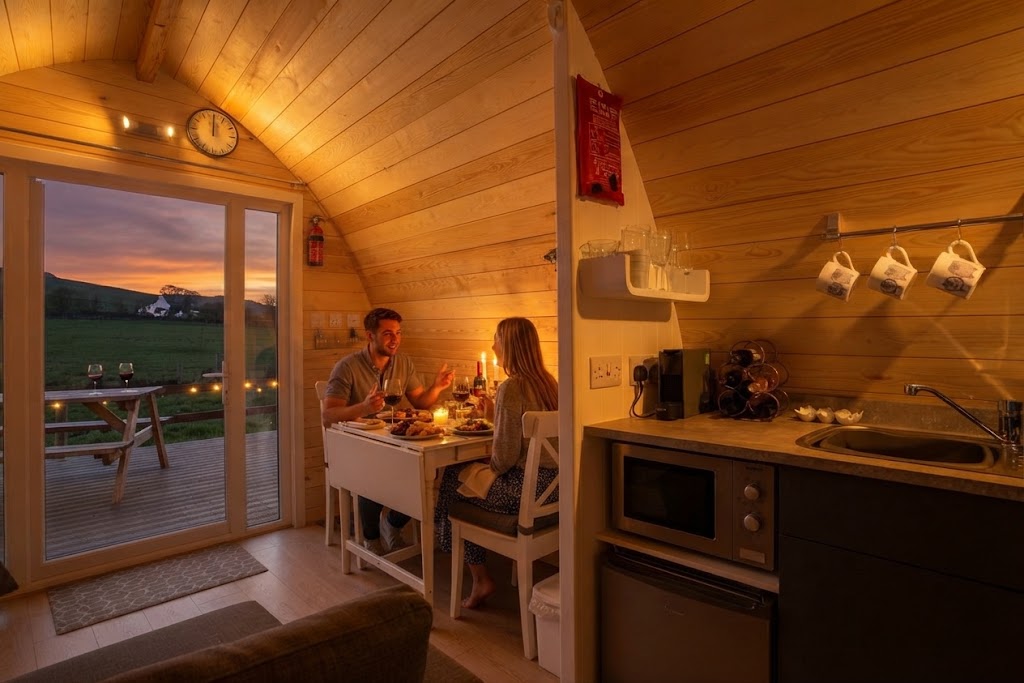
- A glamping burrow is an earth-sheltered unit dug into a hillside with a grass roof, a round door and central heating inside.
- Sold as a two-night escape package at The Quiet Site above Ullswater, usually £280–£420 for the two nights.
- Thermal mass makes it warm in winter and cool in summer with almost no energy input.
- Suits couples, and suits families with children even better — the novelty is genuine.
- Book well ahead. There are very few of these and they are the site's headline units.
Introduction to the Glamping Burrow Escape
What is the Two Night Glamping Burrow Escape?
The Two Night Glamping Burrow Escape is a packaged short break: two nights in an earth-sheltered glamping burrow at The Quiet Site above Ullswater, sold as a fixed unit rather than as a nightly rate.
Packaging it as two nights is a sensible reflection of how these units are actually used. A burrow is not a base for a fortnight's walking; it is a destination in itself for a couple of nights. Two nights is enough to enjoy the novelty properly, do one substantial walk and one lake day, and leave before the compact interior starts to feel compact.
What is normally included in a package of this kind:
- Two nights' accommodation in the burrow
- Beds made up with linen, towels supplied
- Central heating and lighting
- Private decking or outdoor seating
- Access to the site's facilities — showers, toilets, shop, bar
- Parking
Always confirm the specifics with the site, since package contents change season to season.
Location: The Beauty of the Lake District
The burrow sits above Watermillock on the western shore of Ullswater, inside the Lake District National Park. Ullswater is the second-largest lake in the district, running nine miles from Pooley Bridge in the north-east to Patterdale in the south-west, bending twice so you never see the whole of it at once.
The western shore rises steeply, which is why sites here have real views: even a few hundred metres up, you get a clear line down the water towards Place Fell and the Helvellyn massif. That is not true at Windermere, where shoreline development blocks most of it.
Within easy reach:
- Ullswater Steamers, connecting Pooley Bridge, Howtown and Glenridding, and useful as one-way walking transport
- Aira Force, a 20-metre waterfall in National Trust woodland, twenty minutes away
- Hallin Fell, 388 metres, forty minutes up from Howtown for the best value view in England
- Helvellyn, 950 metres, via Striding Edge from Glenridding
- Glencoyne Bay, where Wordsworth saw the daffodils, and a good swim
- Pooley Bridge and Penrith for pubs, shops and the mainline station
Features and Amenities of the Glamping Burrow
Accommodation Features of the Glamping Burrow
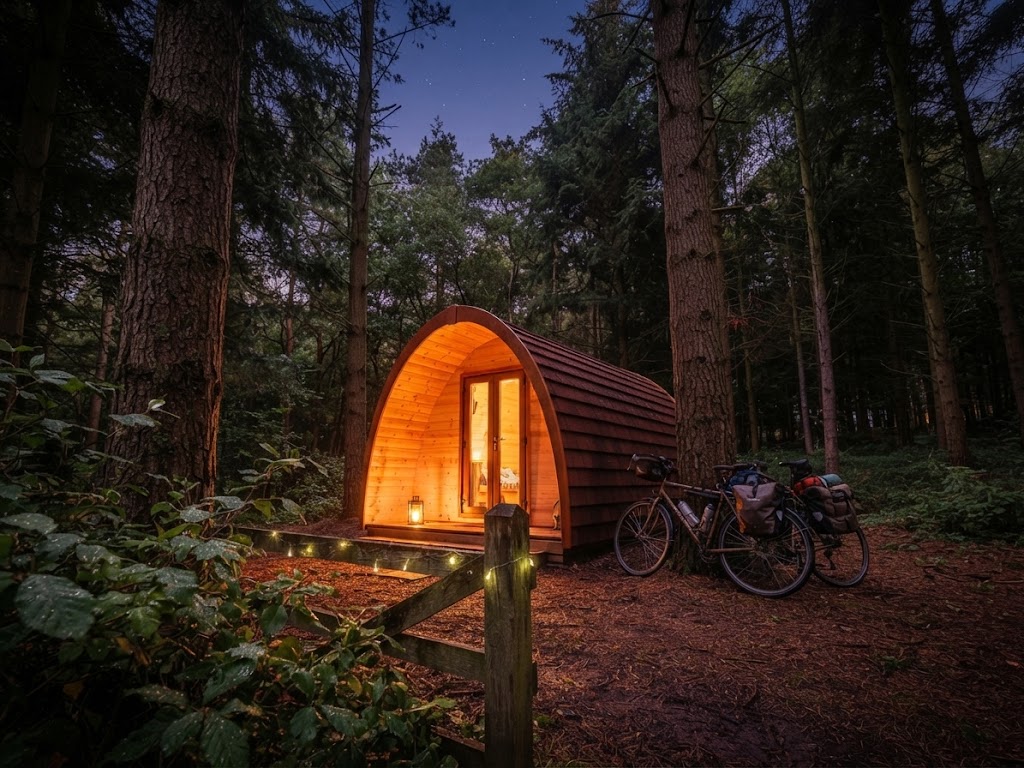
The construction is the interesting part. An earth-sheltered burrow is a small insulated shell — timber or concrete, waterproofed — with soil banked over the roof and sides, planted with grass. Only the front elevation is exposed, and that is where the door and glazing go.
What that construction produces:
- Thermal stability. Soil has enormous thermal mass, so the interior barely responds to outside temperature. Warm in January, cool in July, without much energy input.
- Silence. Earth is an excellent acoustic barrier. A burrow is markedly quieter than a pod, which matters on a busy site.
- Weather immunity. Wind and rain are essentially inaudible.
- Low visual impact. From above, it is a grass bank, which is why this style of build gets planning permission inside a national park.
Inside, the specification typically includes:
- Central heating, which combined with the thermal mass makes winter stays genuinely comfortable
- Made-up bed or beds, with linen and towels
- Lighting and mains sockets
- Seating and a small table
- Glazing in the front elevation for natural light and the view
- Private decking outside the entrance, with furniture — effectively the burrow's living room in good weather
The decking matters more than it sounds. A burrow is compact, and the deck is where you spend the daylight hours. Facing the right way, it is one of the better places to sit in Cumbria.
Amenities at The Quiet Site
The Quiet Site is a family-run site above Watermillock with a long-standing national reputation, and it is worth understanding what it offers beyond the burrows.
- A subterranean bar, which is exactly what it sounds like and is genuinely good
- Shower and toilet facilities, well maintained
- A shop for essentials, firewood and gas
- Multiple accommodation types — burrows, pods, camping pitches, and other units
- Serious environmental engineering: ground-source heating, significant solar generation, biological waste-water treatment, rainwater harvesting, EV charging and extensive recycling. The site has collected national awards for this over many years and the measures are substantive rather than decorative.
- Views west across the fells from the higher parts of the site
- Dark skies, which on the western Ullswater slopes are genuinely good
One honest note on the name. In high season, a site of this size with families on it is not silent, and a minority of reviews find that ironic. Our reading: the environmental work is real and unusually thorough, the accommodation is genuinely unusual, and expectations about noise should be adjusted downwards in August and are entirely met in October. More on the site and its neighbours at glamping at Ullswater.
Suitability and Unique Aspects
Family Suitability: Adults and Children
Burrows split their appeal between adults and children in an unusual way.
For adults: the draw is the thermal comfort, the quiet, and the novelty of sleeping inside a hillside. It is a good two-night escape and a genuinely different experience from a pod.
For children: the draw is that it is a hobbit hole. A round door in a grass bank does something to a seven-year-old that no amount of luxury fittings can replicate. If you are travelling with children and want the accommodation itself to be part of the holiday, this is one of a very small number of options in Cumbria that delivers that.
Practical considerations for families:
- Check the sleeping capacity of the specific unit. Burrows vary; some take two, some four.
- Confirm the bed configuration — a "sleeps four" may mean a double plus a small sofa bed.
- Check the distance to facilities, which with young children matters at 2am.
- The site is family-oriented, so there will be other children, which most families count as a plus.
- Floor space is limited. Two nights with two children is fine; a week would not be.
What Makes the Earth-Sheltered Glamping Burrow Unique?
Very few earth-sheltered glamping units exist in the UK, and the reasons are practical: they are expensive to build, they require serious waterproofing and drainage, and the site needs suitable ground and a slope.
Where the burrow is genuinely better than a conventional unit:
| Earth-sheltered burrow | Glamping pod | |
|---|---|---|
| Winter warmth | Excellent, thermal mass plus heating | Good, depends on insulation |
| Summer coolness | Excellent, stays cool without effort | Poor. A pod in August sun gets hot |
| Noise from outside | Almost none | Moderate |
| Natural light | One end only | Better, one or both ends |
| Visual impact on the landscape | Minimal | Visible |
| Energy needed to heat | Low | Moderate |
| Novelty | High, particularly for children | Low |
| Availability across Cumbria | Very rare | Hundreds |
The environmental case is real, too. A structure that uses a hillside as insulation needs a fraction of the heating energy of an above-ground unit, and it has almost no visual impact on a protected landscape. That combination is why national park planning is more sympathetic to it than to a conventional cabin.
Booking and Availability
Availability for a Two-Night Stay
Burrows are the headline units at the site, and there are not many of them. That combination produces tight availability.
| Period | Book by | Availability |
|---|---|---|
| July–August | 5–8 months out | Poor |
| Easter and half-terms | 4–6 months out | Poor |
| May–June | 2–3 months out | Moderate |
| September | 6–8 weeks out | Good after the first week |
| October–March | 3–6 weeks out | Good, and this is when a burrow is at its best |
Weekend two-night blocks go first. Sunday-to-Tuesday and Monday-to-Wednesday stays are far easier to get and usually cheaper. If the burrow is the reason for the trip, take the midweek dates.
Booking Process for the Glamping Burrow Escape
- Book direct through the site's own system. Established Cumbrian sites run accurate real-time calendars and this one does not need platforms.
- Confirm the specific burrow. They are not identical; aspect and capacity vary.
- Check what the package includes and what costs extra.
- Confirm sleeping capacity and bed configuration against your party.
- Check the dog policy if relevant.
- Note the arrival window, commonly mid-afternoon.
- Read the cancellation terms. Two-night packages tend to have less flexibility than nightly bookings.
- Save the directions offline. The lane up from the A592 is narrow and signal is patchy.
Value and Comparison
Cost and Value of the Two-Night Stay
Expect the two-night package to run £280 to £420 depending on season and unit, which is £140 to £210 a night.
Against the alternatives for the same two nights:
| Option | Two nights, shoulder season | What you get |
|---|---|---|
| Basic camping pod | £190–£250 | Mattress, socket, shared block |
| Standard pod | £250–£310 | Bed made up, kettle, fridge |
| Earth-sheltered burrow | £280–£420 | Central heating, thermal mass, silence, novelty |
| Ensuite pod | £320–£400 | Private bathroom, kitchenette |
| Pod with private hot tub | £480–£620 | Tub, en-suite, privacy |
| Lakeland hotel room | £280–£500 | Service, breakfast, a bath, and a building |
Our value assessment: the burrow is priced roughly where a good standard-to-ensuite pod sits, and it delivers something no pod can. If you would otherwise book a mid-tier pod for two nights, this is better value at similar money. If you would otherwise book a hot tub unit, that is a different trip and the tub probably wins.
Comparison with Other Glamping Sites in the Lake District
Where the burrow sits in the wider Cumbrian market:
- Against farm pod sites (Kentmere, the Lyth Valley): the burrow is more unusual and better insulated; the farm pods are quieter, cheaper and more private.
- Against Eden Valley hot tub sites such as Eden Heights: the burrow has no tub and is inside the national park with lake views; Eden Heights has the tub, drier weather and no lake.
- Against luxury glamping at £300–£450: the burrow is far cheaper and has no private bathroom or tub. Different segment.
- Against safari tents for families: the safari tent has bedrooms, a kitchen and floor space; the burrow has novelty and a twelve-month season.
- Against a large campsite pod field: the burrow wins on everything except price.
Who we would send here: a couple wanting a two-night escape in October or February where the accommodation is part of the appeal; a family with children between five and twelve who will remember the round door for a decade; and anyone who cares how a site is actually run, since the environmental engineering here is the real thing rather than a page on a website.
Who we would send elsewhere: anyone whose priority is a private hot tub; anyone wanting total solitude in August; and anyone staying a week, for whom floor space will matter more than novelty.
Questions people ask
What is a glamping burrow?
An earth-sheltered accommodation unit built into a hillside, with soil and grass over the roof and a curved or round entrance. Structurally it is a small insulated shell with the hill piled over it. The earth provides thermal mass, so the interior stays warm in winter and cool in summer with very little heating input.
Where is the Glamping Burrow?
At The Quiet Site, on the higher ground above Watermillock on the western shore of Ullswater, in the Lake District National Park. The site is family-run and known nationally for its environmental engineering as much as for its unusual accommodation.
Is a burrow suitable for children?
Very. In our view children get more out of it than adults do — a round door in a hillside with a grass roof reads as a storybook come to life. Check the specific unit's sleeping capacity, because burrows vary and some are strictly two-person.
Is it dark inside an earth-sheltered burrow?
Less than you would think. Glazing goes in the front elevation, which is the exposed face, so the living space is naturally lit from one end. It is dimmer than a glass-fronted cabin and considerably better for sleeping.
How does a burrow compare with a glamping pod?
The burrow is warmer in winter, cooler in summer, quieter, and far more interesting. A pod is lighter inside, more widely available and cheaper. For a two-night escape where the accommodation is part of the point, the burrow wins comfortably.