Sites & etiquette
Experience Glamping in the Lake District with Luxurious Hot Tubs
Two very different hot tub sites, side by side: a working farm campsite and a small hill retreat. Plus the etiquette nobody explains and the numbers nobody publishes.
TL;DR
- Rustic farm campsites and small hill retreats are the two hot tub models. One costs £170–£240, the other £250–£350.
- Wood-fired suits a longer stay. Electric suits one night and tired legs.
- Etiquette that matters: 20-minute sessions, no alcohol, shower first, 10pm curfew, no glass.
- Visit Lake District is the free planning resource worth using before you book anything.
- Ask two questions before paying: is the tub exclusively ours, and will it be hot on arrival.
Discover Glamping in the Lake District
Top Glamping Sites in the Lake District
The Lake District is England's largest national park — 2,362 square kilometres, sixteen major lakes, 214 Wainwright fells, and a UNESCO World Heritage listing since 2017. It is also the country's densest concentration of small glamping operators, largely because farm diversification and national park planning policy happened to point the same way.
The recognisable site types, and where hot tubs turn up in each:
- Working farm campsites. Pods or huts on grazing land, often with a wood-fired barrel tub. £170–£240 with a tub.
- Small hill and valley retreats. One to four units, private electric or wood-fired tubs, decking. £250–£350.
- Large established campsites. Pod fields with good facilities. Tubs uncommon, sometimes shared.
- Guest-house and pub pods. Units in a garden or paddock. Tubs rare.
- Curated design properties. Architect-built, marketplace-listed, almost always with a tub. £280–£450.
Unique features of glamping here, as distinct from anywhere else in Britain: the rain, which pushed the market towards insulated timber rather than canvas; the fells, which mean a hot tub is genuinely functional rather than purely decorative; and the sheer number of one and two-unit sites, which is why a £250 stay can involve seeing nobody for two days.
Luxury Glamping Pods: Comfort in Nature
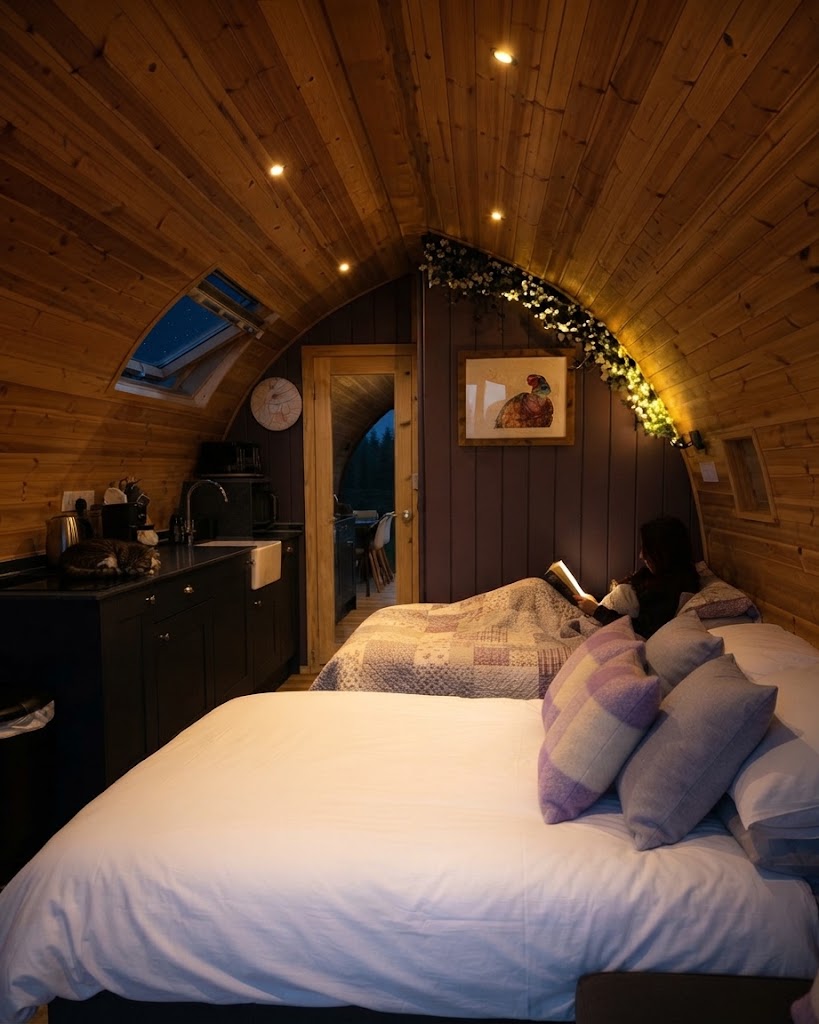
Luxury glamping pods are the tier where en-suite and hot tub arrive together. Specification, typically:
| Element | Standard pod | Luxury pod |
|---|---|---|
| Bathroom | Shared block | En-suite shower and WC |
| Hot tub | None | Private, screened |
| Bed | Double, made up | King, made up, towels |
| Kitchen | Kettle, fridge | Hob, sink, fridge, crockery |
| Heating | Panel heater | Thermostatic or underfloor |
| Footprint | 12–18m² | 20–30m² |
| Units on site | 6–30 | 1–4 |
| Nightly rate | £125–£160 | £240–£400 |
The benefit that justifies the gap is not the fittings but the unit count. One or two pods on ten acres produces a genuinely different holiday from a fitted-out pod in a field of twenty. Privacy is the product. Everything else is packaging.
Sites offering the tier cluster in the Eden Valley, the Lyth and Winster valleys, the Cartmel area, and the eastern approaches to Windermere. Detail on the top end at luxury glamping and luxury camping.
Hot Tub Options for Glamping
Availability of Hot Tubs at Glamping Sites
Around a quarter of Lakeland glamping sites offer a hot tub in some form, and the form matters enormously. Three arrangements get filtered identically on booking platforms:
- Private and screened. Yours for the stay, nobody can see in. What you are picturing.
- Private but exposed. Exclusive use, sited where guests walk past to reach the bins.
- Shared on a rota. One tub, several units, booked in hour slots.
Ask for a site plan. Ask whether the tub is exclusively yours for the whole stay. Ask whether anyone can see into it. Sites that answer all three quickly and specifically are sites that have thought about it.
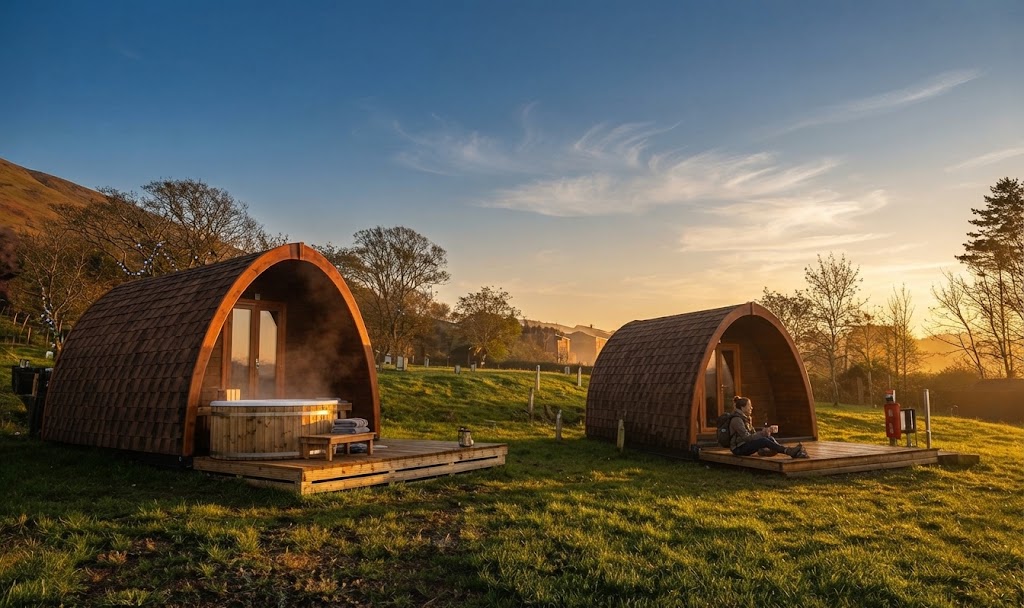
Wood-fired and electric tubs behave differently enough to be worth understanding before you arrive. Wood-fired is a barrel with a stove: two to three hours to heat, no jets, no chemicals, drained and refilled between guests. Electric is an acrylic spa: thermostat, filtration, chlorine or bromine, jets, ready when you get there.
Benefits during a Lakeland stay, in order of how much they matter:
- Muscle recovery after a fell day. This is not marketing; it works
- An evening you can actually spend outdoors in April or October
- Rain becomes irrelevant, then pleasant
- Dark-sky stargazing from warm water
- The occasion factor, if the trip is a birthday or anniversary
Comparing Wood-fired and Electric Hot Tubs
Wood-fired, the case for: no chlorine smell, no pump noise, fresh water for every guest, a fire to tend, and a slow build to temperature that turns the tub into an event rather than an appliance. Cheap for the operator to install and run, which is why small farm sites favour them.
Wood-fired, the case against: two to three hours' lead time, no jets, temperature managed by feel and firewood, and a real risk of getting it wrong on a cold night. If you arrive at seven expecting to be in water by half past, you will be disappointed.
Electric, the case for: ready on arrival, thermostatically stable, jets that do something useful for a stiff back, and consistent from one night to the next. Better for one-night stays and for families who cannot wait three hours.
Electric, the case against: a faint chemical smell, a pump that hums, and dependence on the site keeping the water chemistry right. When electric tubs go wrong they go wrong invisibly.
| Your trip | Recommended tub | Why |
|---|---|---|
| One night, arriving late | Electric | Ready immediately |
| Two or three nights, autumn | Wood-fired | The ritual is half the value |
| Family with young children | Electric | Thermostat and predictability |
| Walking hard every day | Electric | Jets, and no waiting after a long day |
| Anniversary, no fixed plans | Wood-fired | Better atmosphere, better photographs |
| Deep winter | Electric | Wood-fired takes 3–4 hours in January |
Explore Specific Glamping Locations
Moss Howe Farm Campsite: A Rustic Retreat
Moss Howe Farm Campsite sits in the Witherslack area of the southern Lake District, in the low, wooded country between the Lyth Valley and Morecambe Bay. It is a good example of the working-farm model, which is where a large share of Cumbria's most interesting glamping actually lives.
Features characteristic of this style of site:
- A real farm around you. Livestock, machinery, hedges, and the noises that come with all three.
- Space per pitch. Farms have land, so units sit further apart than on a commercial campsite.
- Simple facilities. A clean shower block rather than a leisure complex.
- Wood-fired tubs where tubs exist, drained between guests.
- Fire pits and usually firewood for sale at the gate.
- Owner on site, which is both the reassurance and the reason there is no reception desk at 11pm.
Why the southern Lakes work as a base: this corner is drier than the central fells, considerably quieter, and better placed for the food. Cartmel, with its priory and its disproportionate concentration of good kitchens, is close. Scout Scar above Kendal gives a big view for forty minutes' effort. Grange-over-Sands and the Morecambe Bay marshes are unlike anywhere else in the national park. Windermere is twenty minutes north.
What visitors to farm sites in this area consistently report: genuine peace, generous space, dark skies, and owners who know exactly which lane to avoid on a Saturday. The recurring reservations are equally consistent — single-track access, no mobile signal, and a drive to reach the high fells. None of that is a fault. It is the deal.
Eden Heights Glamping: Luxury in the Hills
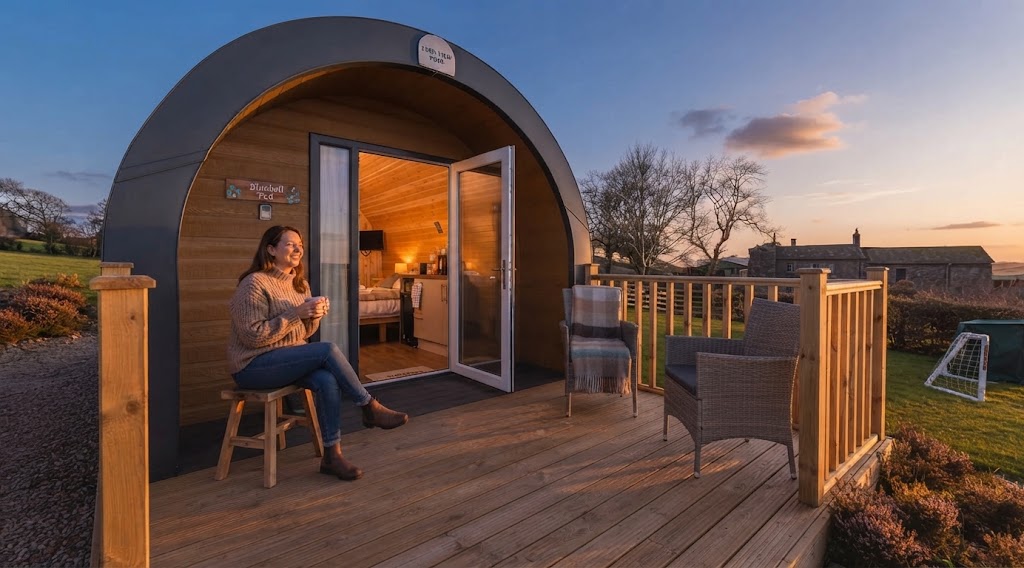
Eden Heights Glamping operates on the eastern edge of the national park, in the Eden Valley near Penrith. The model is the opposite of a farm campsite: a small number of well-appointed units with private hot tubs, sold on privacy rather than facilities.
The structural advantage is weather. The Eden Valley lies in the rain shadow of the central fells, recording roughly 900 to 1,000mm of annual rainfall against 2,000mm and considerably more in Borrowdale. Over a five-night stay that difference is several dry evenings, which is precisely what a hot tub holiday needs.
Unique features of this position:
- Two horizons: the Lakeland fells west, the North Pennines east
- Red sandstone villages and gentler contours than the central park
- Penrith's supermarkets, market and mainline station within minutes
- M6 junction 40, which makes arrival genuinely easy
- Lowther Castle and Gardens, Ullswater and Aira Force all within half an hour
Feedback for glamping in this part of Cumbria splits cleanly. Warm on the quiet, the space between units, the number of usable evenings and the ease of getting there. Cooler on the distance to the high fells — Ullswater is twenty to thirty minutes, Keswick nearer forty. For a walking-focused week that mileage compounds; for a hot tub-focused break it is irrelevant. Our fuller look at the operator: Eden Heights Glamping review.
Planning Your Glamping Trip
How to Plan a Visit to the Lake District
A sequence that works for a hot tub trip specifically:
- Choose the season first. October to April is when the tub earns its money. Book the tier then.
- Choose the tub type, which follows from your stay length and arrival time.
- Choose the valley. Eden and Lyth for dry evenings, Ullswater for views, Windermere for restaurants.
- Ask the two questions. Exclusively ours? Hot on arrival?
- Confirm the curfew and any separate tub charge.
- Book direct, and ask for an early arrival so a wood-fired tub can be lit.
Best times to visit for glamping with a tub:
- Late September to early November. Our pick. Cheap, atmospheric, cold enough for the tub to matter, and the fells are at their best colour.
- February. Cheapest of all. Clear cold nights, excellent stars, empty paths.
- Mid-May to mid-June. Driest weeks, long evenings, moderate prices.
- July and August. The tub is a luxury you will use twice. Save your money.
Visit Lake District is the official destination management organisation and the best free planning resource: events calendar, travel and road updates, accessible routes, public transport. The Lake District National Park Authority covers parking, path conditions and conservation. Check the Met Office mountain forecast rather than the town one for anything above 400 metres.
Cost and Booking Information for Glamping
Average costs, two adults, one night, with a private hot tub:
| Site type | Low season | Shoulder | Peak |
|---|---|---|---|
| Farm campsite, wood-fired tub | £140–£180 | £175–£230 | £220–£290 |
| Small retreat, electric tub | £185–£240 | £240–£300 | £300–£390 |
| Shepherd's hut with tub | £175–£230 | £230–£290 | £280–£360 |
| Curated design property | £220–£290 | £280–£360 | £350–£450 |
Booking tips: go direct, always, for anything involving a tub. Platforms cannot tell you whether the fire will be laid or whether the neighbours can see in. Direct booking also gets you the flexible arrival that a wood-fired tub needs.
Special offers worth hunting: midweek deals in November and February, third-night-free promotions in shoulder season, and returning-guest rates that small sites offer informally. Sign up to the mailing lists of two or three sites you like — cancellations get announced there before anywhere else.
Hot tub etiquette, since nobody tells you
- Rinse or shower before getting in. It keeps the water usable for the rest of your stay.
- Twenty minutes maximum, then get out and cool down. Repeat if you want.
- No glass. Not a bottle, not a wine glass. Broken glass means the tub is out of action.
- Keep the volume down after nine. Sound travels absurdly far in a quiet valley.
- Replace the cover when you finish. It saves heat and keeps leaves out.
- Do not get in with sun cream, fake tan or heavy make-up on.
- Pregnant guests and anyone with a heart condition should check with a GP first.
User Experiences and Reviews
Visitor Reviews of Glamping in the Lake District
Across hot tub glamping reviews in Cumbria, the same signals repeat.
Consistently praised: the tub, essentially without exception; genuine privacy where it exists; owners who left clear instructions and a laid fire; and the value of the whole thing against a Lakeland hotel with a spa.
Consistently criticised: tubs not at temperature on arrival; discovering the tub is shared or overlooked; separate charges that were not obvious; curfews that came as a surprise; and water quality at sites that dose rather than drain.
Common themes in the feedback that are worth acting on:
- Sites that communicate well before arrival get better reviews than sites with better facilities. Operations beat specification.
- Small sites outscore large ones on almost everything except facilities.
- Nobody complains about rain at a hot tub site. They complain about it everywhere else.
- Shared tubs generate the angriest reviews in the whole category, because expectations were set wrong.
Tips from past visitors, distilled: light the fire earlier than you think you need to; bring flip-flops; take a metal cup; ask for the pod furthest from the entrance; and book the last week of September if you possibly can.
Questions people ask
What is hot tub etiquette at a glamping site?
Shower or rinse before getting in. Twenty minutes maximum per session. No glass anywhere near the tub. Keep the volume down, especially after nine. Replace the cover when you finish, which keeps the heat and the leaves out. And do not top up the water yourself unless the owner asked you to.
Should I bring anything specific for a hot tub stay?
Flip-flops, a robe or an old hoodie for the walk back, a bottle of water, and a plastic or metal cup. A head torch helps if the tub is away from the pod. Towels are supplied at the en-suite tier and often not at the basic tier.
Can you drink alcohol in a glamping hot tub?
Sites permit it and we would advise against much of it. Hot water accelerates alcohol absorption and dehydration together, which is why hot tub accidents skew heavily towards people who had a few drinks. One glass, plenty of water, and get out before you feel woozy.
Do farm campsites have worse hot tubs than luxury sites?
Not worse, plainer. Farm sites tend to run wood-fired barrels, drained between guests, with no jets. Luxury sites run acrylic spas with filtration and jets. The farm tub is often in a better spot.
Is a hot tub worth it in July?
Marginally. On a warm evening you will use it once or twice and then wonder about the £90 a night. In April, October or February it is the reason the evening works at all. Book the tub tier out of season and save the money in summer.