Tub types
Lake District Hot Tub Glamping: Types, Windermere and What to Book
A shorter, more practical page. Which tub, which base, which walk, and whether the whole arrangement is worth what it costs.
TL;DR
- Wood-fired tubs are the better experience; electric tubs are the better appliance. Pick by stay length and arrival time.
- Windermere gives you the boats, the train and the restaurants at a 15–25% premium.
- Whinlatter and Grizedale for riding; Catbells, Helvellyn and Orrest Head for walking.
- Eden Heights and the Eden Valley generally trade fell access for dry evenings.
- Budget £220–£400 a night in season, £175–£250 out of it.
Discover Glamping in the Lake District
Available Glamping Sites
Glamping in Cumbria means a furnished, permanent or semi-permanent structure in a field, with a bed and mains power supplied. Inside the Lake District National Park — 2,362 square kilometres, sixteen major lakes, 214 catalogued fells — there are several hundred such operations, most of them small.
The site types you will encounter:
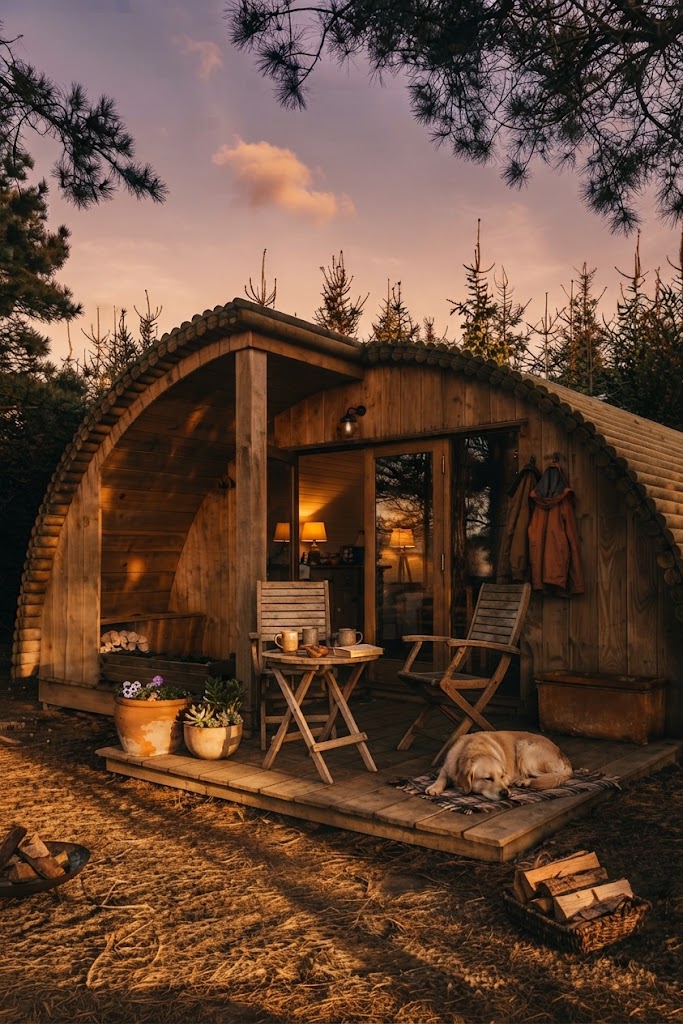
- Farm pod sites, two to six units on grazing land. The most common and often the best value.
- Campsite pod fields, eight to thirty units with proper facilities blocks.
- Shepherd's hut retreats, one or two huts, adults, wood burner, usually a tub.
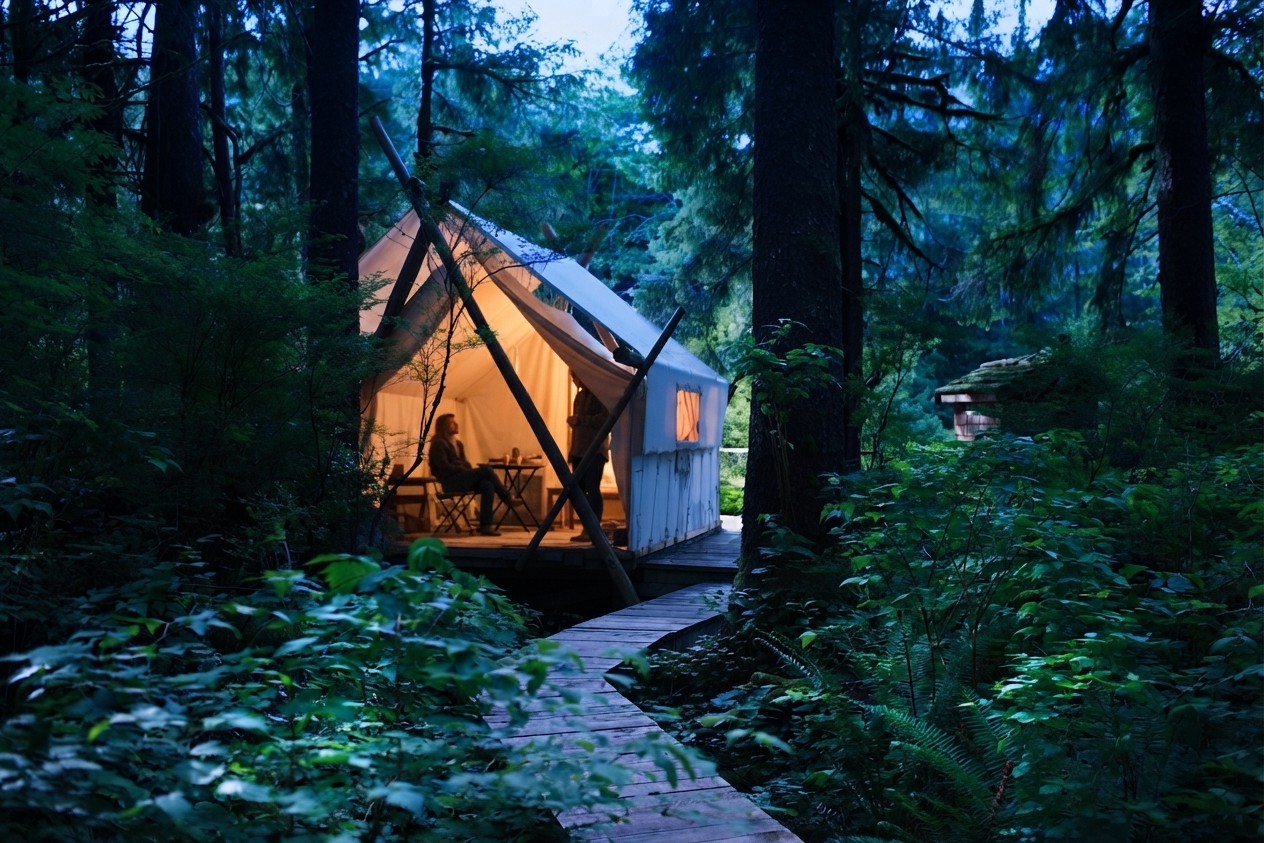
- Canvas sites, yurts, safari tents and bell tents, April to October.
- Curated design properties, architect-built one-offs listed through marketplaces.
What makes Cumbria attractive to glamping enthusiasts specifically: the density of landscape, the fact that the weather rewards good accommodation, and the abundance of one and two-unit sites where the entire point is that you see nobody. A hotel cannot deliver a field to yourself. A pod on a farm can, for £180.
Glamping Sites with Hot Tubs
Around one site in four has a tub. They concentrate where there is land to spare and demand to justify it:
| Area | Tub rate, season | Tub type usually | Best for |
|---|---|---|---|
| Eden Valley | £220–£320 | Both | Dry evenings, privacy, easy arrival |
| Lyth & Winster valleys | £210–£300 | Wood-fired | Quiet, food, southern Lakes |
| Windermere fringe | £250–£400 | Electric | Boats, restaurants, train access |
| Ullswater | £220–£330 | Both | Views, swimming, Helvellyn |
| Cartmel & Cartmel Fell | £230–£340 | Electric | Eating properly, then sitting in water |
| Keswick & Borrowdale | £190–£280 | Wood-fired | Walking hard, cheaper tubs |
Benefits during a Lakeland stay: muscle recovery after the fells, an outdoor evening in months when you would otherwise be inside, rain that stops mattering, and stargazing from warm water in some of England's darkest skies.
How to choose the right site with a tub — four questions, in order:
- Is the tub exclusively ours for the whole stay? If the answer involves the word "rota", move on.
- Can anyone see into it? Ask for a site plan or a photo taken from the footpath.
- Will it be hot when we arrive, or do we light it? Changes your whole first evening.
- Is there a separate charge? £30 to £50 per stay at a minority of sites.
Luxury Glamping Options
Luxury Glamping Pods
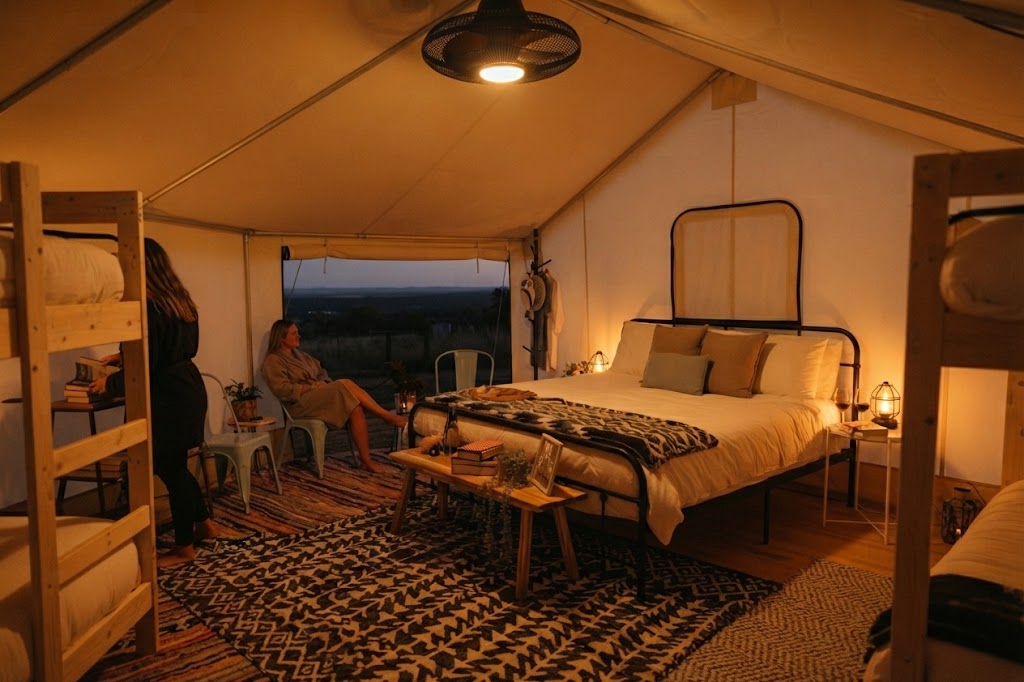
Luxury glamping pods in the Lake District mean, in practice, a pod with an en-suite bathroom and a private hot tub, at £240 to £400 a night. Amenities at that level:
- King bed, made up, linen and towels included
- En-suite shower room with genuine water pressure
- Kitchenette: induction hob, fridge, sink, crockery
- Underfloor or thermostatic heating
- Private decking with furniture worth sitting on
- Screened hot tub with functioning outdoor lighting
- 20 to 30 square metres rather than 12 to 18
- One to four units on the whole site
Comparing luxury pods against each other, the differentiators are unit count, tub type and view. Fittings converge quickly at this price — every site has the same induction hob. What differs is whether you can see a neighbour, whether the tub is wood-fired, and whether the window frames a fell or a hedge.
Why choose the premium tier: because the en-suite removes the worst part of glamping, because privacy is genuinely scarce in a national park with 18 million visitors, and because in October the tub is the difference between an evening outside and an evening indoors. Why not to: in August, with children, when floor space matters more than fittings. Compare with luxury glamping and Windermere luxury camping pods.
Wood-fired Hot Tubs
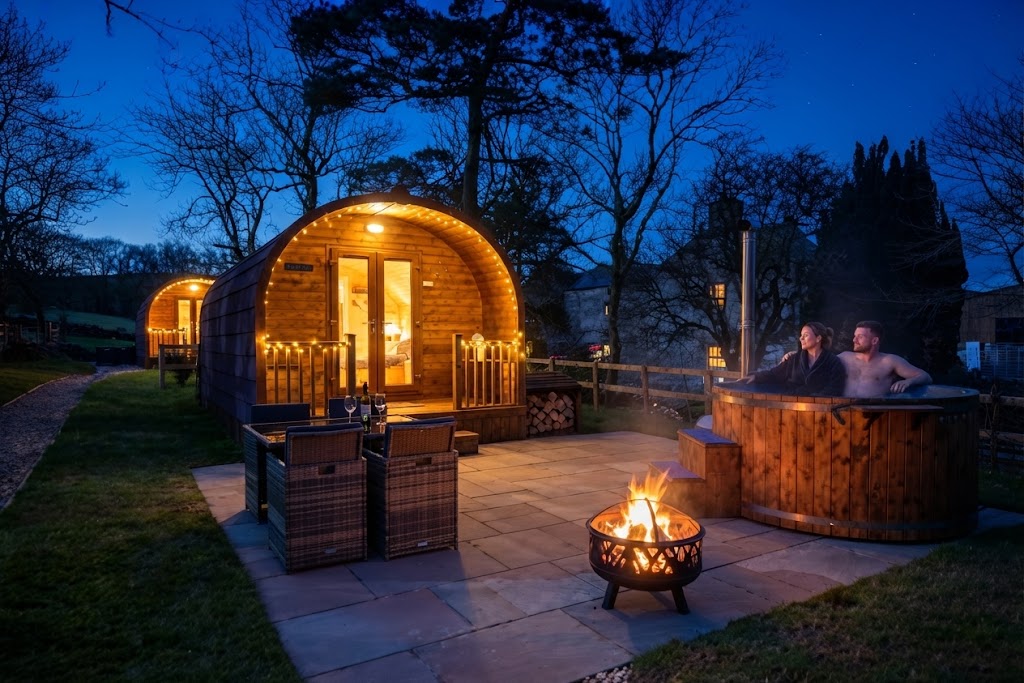
A wood-fired hot tub is a timber or fibreglass barrel with an integrated stove, either submerged in the water or mounted outside with a jacket. There is no pump, no filter and usually no chemistry. The water is drained and refilled between guests.
The appeal is the process. You arrive, you lay a fire, you feed it for a couple of hours while you unpack and cook, and the water climbs from ambient to about 38°C. By the time you get in, you have earned it. No motor noise, no chlorine, and the faint smell of woodsmoke on your skin afterwards.
Where they turn up: small farm sites, shepherd's hut retreats, eco-focused operations, and the Eden, Lyth and Winster valleys generally. Larger and more expensive sites tend to install electric spas, because guests expect jets and because a thermostat is easier to defend when someone complains about temperature.
How wood-fired tubs change the stay:
- The evening organises itself around the tub rather than the tub being an add-on
- You need to be back at the site by mid-afternoon, which quietly improves the pacing of the day
- Water quality is a non-issue, since it is fresh
- You will get it slightly wrong on the first night and right on the second
Practical notes: allow two to three hours in summer, three to four in January. Stir the water before you get in, because wood-fired tubs stratify badly and the top can be 42°C while your feet are at 30°C. Keep the cover on while heating. And do not stack the firebox to the roof unless you enjoy adding cold water later.
Explore the Lake District
Glamping Near Windermere
Windermere is England's largest natural lake: 16.9 kilometres long, up to 64 metres deep, with a developed eastern shore that has been receiving tourists since the railway arrived in 1847. For hot tub glamping it is the most expensive part of Cumbria and, for some trips, the most convenient.
Sites near Windermere sit on the eastern and southern approaches rather than the shoreline, because lakeside development is heavily restricted inside the national park. Expect five to twenty minutes to the water. Expect £250 to £400 a night in season for a pod with a private tub.
Activities and attractions around Windermere:
- Windermere Lake Cruises between Bowness, Ambleside and Lakeside. Also useful as one-way walking transport.
- Orrest Head, forty minutes from Windermere station, the view that converted Wainwright in 1930.
- Hill Top, Beatrix Potter's farm at Near Sawrey, and Wray Castle on the western shore.
- Blackwell, the Arts and Crafts house above Bowness, and genuinely worth a wet afternoon.
- Paddleboard and kayak hire at Bowness and Ambleside through the summer.
- Cartmel, twenty-five minutes south, for the priory and the best food in the region.
The trade-off is traffic. The A591 between Windermere and Ambleside in August is slow and unpleasant, and parking in Bowness at eleven o'clock on a Saturday is a competitive sport. See Windermere glamping pods and Lake Windermere pods.
Activities: Cycling and Hiking
Cycling routes worth planning around:
- Whinlatter Forest, near Keswick. Altura Trail, blue and red graded, England's only true mountain forest. Bike hire on site.
- Grizedale Forest, between Coniston and Hawkshead. North Face Trail is the classic. Green through black.
- Lyth and Winster valley lanes. Quiet, hedged road riding, damson blossom in April.
- Kirkstone Pass from Ambleside. The Struggle, with 20% ramps. A genuine test.
- Honister and Newlands loop from Keswick. Two hard passes, 25% sections, extraordinary scenery.
Hiking trails near hot tub clusters:
- Catbells, 451m, from Keswick. Two hours, ridge throughout, the best short walk in England.
- Helvellyn, 950m, via Striding Edge from Glenridding. Six hours, real scrambling, avoid in high wind.
- Hallin Fell, 388m, above Ullswater at Howtown. Forty minutes for a disproportionate view.
- Orrest Head, 238m, from Windermere. Forty minutes, and it starts at the station.
- Scout Scar, above Kendal. An hour of limestone edge with the whole southern Lakes laid out.
- Scafell Pike, 978m, from Wasdale. Five hours. England's highest, and a rubble slog rather than a beautiful line.
How these complement a hot tub stay: the sequence of hard effort, then hot water, then food, then sleep is difficult to improve on. Practically, plan the walk to finish by four so a wood-fired tub can be lit and hot by seven. Carry waterproofs, a map and compass, food and a head torch, and check the Met Office mountain forecast rather than the town one.
Evaluate and Plan Your Stay
Eden Heights Glamping Review
Eden Heights Glamping operates in the Eden Valley near Penrith, on the eastern edge of the national park. The offer is a small number of well-equipped units with private hot tubs, sold on space and privacy rather than facilities.
What it does well:
- Weather. The Eden Valley sits in the rain shadow of the central fells and records roughly a third of Borrowdale's rainfall. Over five nights that is several usable evenings.
- Access. Penrith station on the West Coast Main Line, M6 junction 40, supermarkets and a market town within minutes.
- Space. Small unit count on open farmland, which is what the privacy actually depends on.
- Two horizons. Lakeland fells west, North Pennines east. Unusual and underrated.
What it costs you:
- Distance. Twenty to thirty minutes to Ullswater, nearer forty to Keswick. Over a walking week that is real driving.
- Drama. Farmland rather than fellside. Handsome, not spectacular.
- Price. The tub tier here sits at £220 to £320 in season.
Reasons to choose it: a couples' break where the evenings matter more than the summits, a trip in October or February when dry weather is worth paying for, or a first visit arriving by train. Reasons not to: a fell-bagging week, or a family holiday where children need somewhere to run. Longer treatment on the Eden Heights review page.
Planning Your Visit
Steps to plan a hot tub glamping trip that actually works:
- Pick the season for the tub, not the weather. October to April is when it earns its money.
- Pick the tub type from your arrival time. Late arrival means electric.
- Pick one valley and stay in it.
- Ask the four questions from the section above before paying anything.
- Plan the hard walk for the day, and the tub for the evening. Not both at six.
- Shop once, including water for the tub sessions.
- Note the curfew and plan the last soak before it.
Free resources worth using: Visit Lake District for events, travel updates and accessible routes; the National Park Authority for parking and path conditions; and the Met Office mountain forecast for anything above 400 metres.
Three things that make the most difference to a tub stay: arriving early enough to light it, bringing flip-flops and a robe, and booking the last week of September. That week is warm enough to swim in a lake and cold enough at night to want hot water, and it costs 20% less than August.
Questions people ask
Which Lake District glamping sites have wood-fired hot tubs?
Mostly small farm sites and shepherd's hut retreats, concentrated in the Eden Valley, the Lyth and Winster valleys and around Cartmel. Larger and more expensive sites tend towards electric spas instead. Filter for "wood-fired" specifically, since platforms lump both types together.
Can I glamp with a hot tub near Windermere?
Yes, on the eastern and southern approaches rather than the shoreline — lakeside development is restricted inside the national park. Expect £250 to £400 a night in season, which is the highest tub pricing in Cumbria.
Is a hot tub useful after a long walk?
Genuinely, yes. Warm immersion increases blood flow to tired muscle and most people report sleeping better afterwards. It is not a substitute for stretching or for eating properly, but after six hours on Helvellyn it is the best twenty minutes of the day.
Do hot tub glamping sites allow dogs?
Many do, and none will let the dog in the tub. Expect £8–£15 per dog per night. A few luxury tub sites are adults-and-no-pets, so check rather than assume.
What temperature are glamping hot tubs?
Electric tubs run at a thermostat setting of 37 to 38°C. Wood-fired tubs are managed by feel, and can easily overshoot to 42°C if you keep feeding the stove. Add cold water rather than enduring it.